TEFL (Teaching English as a Foreign Language)
Authored By:

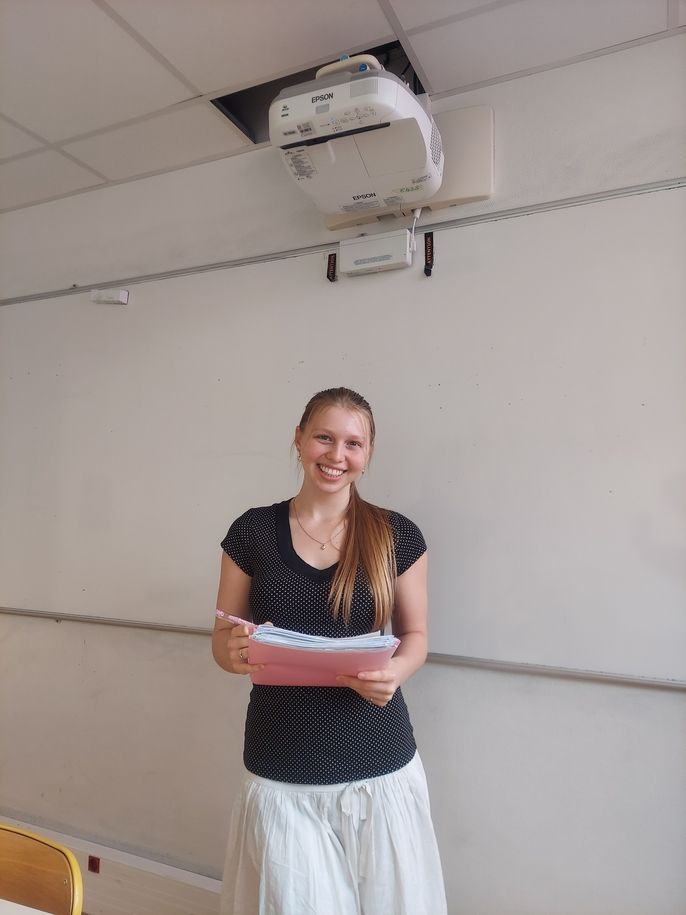
What’s my favorite part of academics while studying abroad through CIEE, you ask? Why, TEFL, of course!
TEFL, which stands for Teaching English as a Foreign Language, is a semester-long course offered by CIEE that allows students to become English teachers alongside weekly language pedagogy classes. Essentially, I plan and teach one lesson every Tuesday at a local French high school, and I receive feedback and advice from not just my own TEFL professor, but also from the English teacher whose class I’m assisting with.
As a French and Hispanic Studies Double Major with an Education Concentration (yeah, I know it’s a mouthful!), TEFL is what drew me to CIEE Rennes in the first place. I’ve been tutoring, mentoring, and working as language TAs for quite some time, but my ultimate goal is to work as a language teacher for some time after graduating. When I heard about an opportunity to get real-world experience teaching an entire classroom of students, I started my application for this program immediately—far sooner than necessary, I might add, but hey, I was excited!
I was lucky enough to be placed in a high school setting, which was my top choice, and my two TEFL classmates are both teaching elementary schoolers. The difference in language abilities and age means that during our one-hour-long pedagogy class, we cover a variety of different techniques for adapting content and teaching techniques to different audiences. Most of my language teaching experience has been with beginner-level students, so I’ve been learning a great deal about how to transform my lessons to best suit a more advanced group.
TEFL has been a wonderful experience for me so far; I’m able to experiment with what works and what doesn’t as a teacher in a setting where there are mentors to guide me, but where I am ultimately afforded the freedom to develop my teaching abilities in a more independent way than I’ve had a chance to in the past. Self-reflection is obligatory after every lesson so that we can think critically about what changes to make in the next lesson, which is my favorite part about learning how to teach. It’s not about being critical of what I did last time; it’s about adapting my teaching to provide a better experience for my students every time I see them.
My last lesson was introducing the students’ new unit, which is on artificial intelligence. A topic with as much nuance and controversy as AI requires students to be able to express their opinions in a respectful way, so we’re reviewing ways to communicate agreement and disagreement while discussing the benefits and disadvantages of generative AI. Each lesson takes quite a bit of planning, but there’s no feeling that compares to watching your students become animated and interested in class and knowing that your hard work is paying off.
I’ve also loved getting to know more about the French school system; I’ve felt so welcome these first few weeks at the high school by students who enthusiastically answer my questions about cultural differences between the American and the French ways of doing things. And they had lots of questions for me, too, from “Is it true that Americans aren’t very good at geography?” (depends on the person) to “Are the AI data centers in the US really using up all of the drinking water in some cities?” (unfortunately).
It’s these moments of curiosity and connection that remind me just how beautiful of a thing it is to take part in a cultural exchange program. I am a foreigner in France, and I am grateful that my home language and background allow me the privilege of being treated as an equal. It is not so for everyone.
All in all, TEFL is an opportunity to expand one’s experience abroad in ways that cannot be accessed through regular classes, tourism, and extracurriculars. If you’re on the path to teaching and on the fence about studying abroad, I recommend just going for it.
Camille Coker
Oberlin College
CIEE-Rennes Liberal Arts Spring 2026
Related Posts
Making Friends Quick: With CIEE!
The start of my term staying in Rennes has been an absolute blast. With every day comes a new adventure, and I owe that in no small part to the... keep reading
Sustainability in Rennes : my first impressions.
Hello curious reader and possible future CIEE program attendee! To start as a little welcome mat, I wanted to discuss my overall, general impressions of Rennes, France, while specifically focusing... keep reading
Volunteering at a Nursing Home in Rennes
When I learned about the collaboration between CIEE and a nursing home in Rennes, I was excited and reassured. As a student on the pre-health track, I was very hesitant... keep reading