Adapting to Life in a Second Language

Authored By:

My plane landed in Rennes four weeks ago, on the morning of January 9th. I’d spent my last three nights in the United States sleeping on the floor of my roommates' apartment, anxiously waiting for Delta to reschedule my delayed flights. Jet lagged and running on about 13 minutes of sleep, I was met with kisses on the cheekand a whirlwind of questions from my host parents, none of which I understood. It was at this moment that I registered that I was in France.
Prior to this program, the maximum amount of time I’d spent speaking French in one day was maybe three hours. Adjusting to full days in a second language was difficult, and took much more mental energy than I’d anticipated. In the United States, I often find myself passively listening or spacing out during lecture classes. This method, unfortunately, does not work well in France. In order to understand my french speaking professors and classmates, it’s important that I stay attentive all the time. During my first week here, this was especially tiring, and I found myself needing much more sleep than usual. Luckily, the French are very supportive of naps. Inside my university library, there is a room called “salle de repos”; rest room. The room is dimly lit, quiet, and filled with about twenty bean bag mats and pillows. I have already fallen asleep twice here. My host family has also been very understanding of the fatigue that comes with adjusting to a second language. During my first few weeks, they encouraged me to rest frequently and were very patient with my developing language skills.
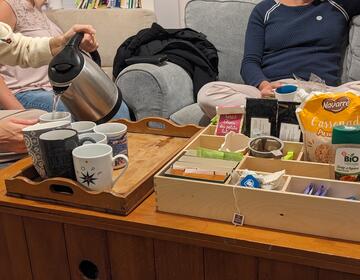
My ability to understand native speakers has improved so much in only a month of living here. My host parents and I share meals together each evening, and talking with them not only allows me to practice my communication skills, but also to learn more about French culture. We discuss current events, traditions, recipes, and more. I feel very lucky to have been placed in such a social family, as they often host book clubs, game nights, and other small gatherings with their friends and neighbors. At each of these events, I try to introduce myself to the guests in order to practice speaking and listening. I’ve found everyone to be very welcoming to conversations, as they are interested to learn about my life in America.
One of the most difficult situations I’ve encountered, in regard to French conversations, has been ordering food or drinks at restaurants. Servers often pick up on my accent and switch to English right away, even though I order in French. I found this to be discouraging at first, but I have come to understand that it is simply more efficient. Unlike the guests at my family’s game nights, servers don’t have time to speak slowly or wait for me to explain that, “yes I speak French, sorry, I’m just from America, umm, so I’m still learning the language...” Realizing that they are not annoyed, just working, has made these situations less discouraging. By the end of this program, perhaps I will come close to passing as a French woman.
Though adapting to life in a second language was difficult at first, I am astounded at how fast I have been able to learn due to this immersive program. Each day, I find myself picking up new phrases and becoming more confident in conversations. I look forward to seeing how much my French will have improved by the end of the semester.
Harper McInroy
St. Olaf College
CIEE-Rennes Liberal Arts Spring 2026
Related Posts

Excursion to Mont Saint Michel
Hello, all ! Mont Saint Michel was a truly magical experience for me and my group ; a maze-like layout coupled with room after room of vaulted ceilings, massive doors... keep reading

My first impressions of Rennes
All summer, I was impatiently waiting for August—I got to go live abroad in France for a short time! I had been looking for an immersion experience in French, and... keep reading
Finding French community: My church in Rennes
While studying abroad, it can be hard to step out of your American circle and meet locals. That's why my host family has been so amazing, but it's also the... keep reading