Taking a Walk Through History: A Mini Tour of Historical Sites Featured in “The Tale of Genji”
Authored By:

Written by Michele Fujii, Academic Director CIEE Kyoto
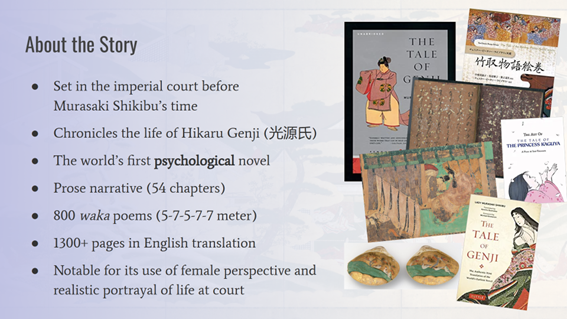
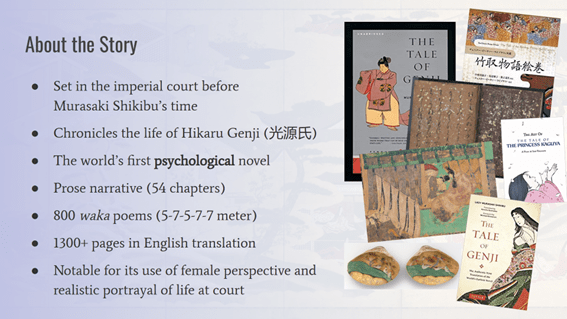
It’s been over a thousand years since the world’s first psychological novel, The Tale of Genji, was written by a noblewoman of the Japanese Imperial court in the late 10th century. The story, composed of 54-chapters, was written over the course of many years, and was inspired by the courtly culture of the Heian period (794-1185).
The author, Murasaki Shikibu, was a member of one of the most powerful and influential families of the period and was brought to court on the merit of her wit and talent at writing to be a tutor to Empress Shoshi.
Courtly culture at the time was highly regulated by complex sets of rules and expectations that dictated everything from the proper attire and behavior for both men and women to the types of gifts that could be exchanged, and they were essential in expressing romantic interest and forming relationships within the courtly circles.
It is this world of courtly romance and political intrigue that she writes about in her novel.
In addition to its being a work of cultural and scholarly merit, it has stood the test of time as a beloved classic of Japanese literature, inspiring a wide range of artwork in nearly every conceivable form from poetry, scrolls, paintings, ukiyo-e woodblock prints, games, crafts, textiles, and more.
We can see its impact and lasting influence on Japanese culture in many aspects even into the modern era, and it has been reimagined for the stage, as anime and manga. Doubtless, you will encounter “The Genji” in some shape or form during your time in Japan.
I’d like to introduce just a handful of culturally significant sites that feature in the novel, and hope that you will take some time to explore them while you’re in Kyoto.
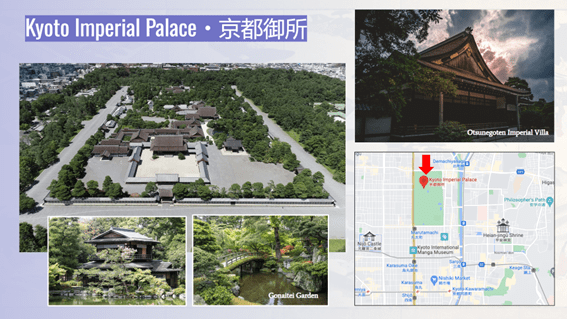
KYOTO IMPERIAL PALACE
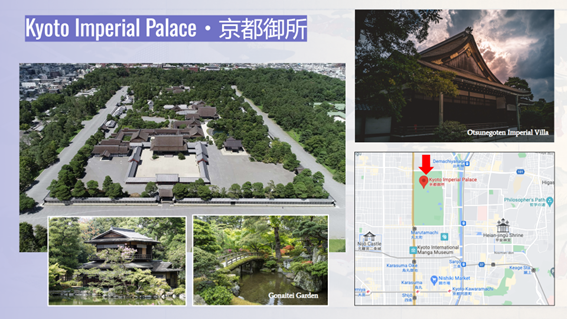
Most of The Tale of Genji takes place within the Kyoto capital city, and many locations closely associated with the novel still exist today, the most important of these being the Kyoto Imperial Palace, where the story begins in Chapter 1.
The palace is where Genji is born, grows up, and where many of the most dramatic events in the novel take place.
Nowadays important court events such as the Kyoto Imperial Palace Tea Party hosted by the Emperor and the Empress sometimes are celebrated here.
The palace also receives state guests and plays an important role as a place that introduces Japanese court culture to foreign dignitaries. On the palace grounds, besides the palace buildings, are two gardens - the Pond Garden is a stroll garden and the Inner garden.
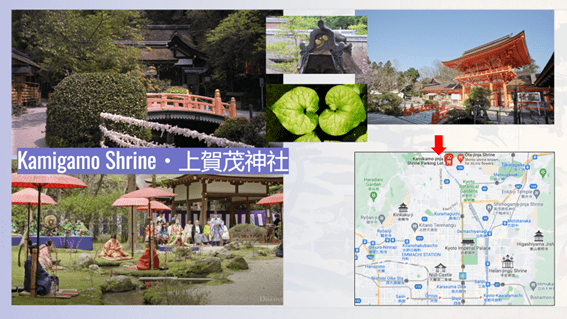
KAMIGAMO SHRINE
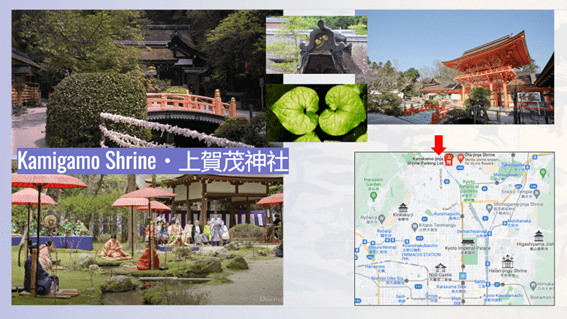
Not far from the Kyoto Imperial Palace is Kamigamo jinja, one of Kyoto’s oldest Shinto shrines which is frequently mentioned in literature of the Heian period.
The shrine is closely associated with hollyhock, or Aoi in Japanese, and this is the title of the Chapter in which it features in The Tale of Genji. The shrine is of special importance not only to the story, but to the people of Kyoto as Kamo shrine is synonymous with the city itself.
Several important events take place here each year, including a poetry competition held in the garden every April which is a modern reenactment of competitions that were held between nobles of the Heian imperial court.
Also associated with the shrine is Aoi Matsuri, also known as the Kamo festival, takes place every year in mid-May, and dates back over 1400 years ago.
A procession of over 500 people dressed in Heian period costume parades through the main thoroughfare of the city, starting from the Kyoto Imperial Palace and ending at the Kamigamo Shrine.
One particular scene from The Tale of Genji from Chapter 9, titled “Aoi,” is one of the most important in the novel. In this scene, an imperial princess is making her procession to Kamo shrine and ladies of the court come out to view the procession in their ox-drawn carts.
Two of these ladies are Lady Rokujo, Genji’s lover, and his wife Lady Aoi.
The two women get into a dispute over where to park and Lady Rokujo’s carriage ends up being damaged. This is a pivotal scene in the novel because Lady Rokujo’s jealous and vengeful spirit comes back to haunt Aoi later in the book.
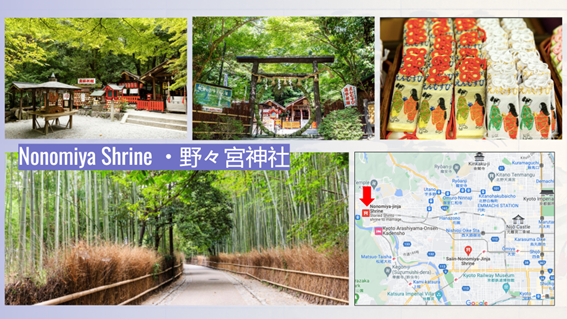
NONOMIYA SHRINE (ARASHIYAMA)
Nonomiya Shrine is a small shrine located on a walking path that takes visitors through the famous Arashiyama bamboo forest.
In the Heian period, imperial princesses stayed in the Nonomiya Shrine for a year or more to purify themselves before becoming representatives of the imperial family at the Ise Shrine in Mie prefecture - Ise shrine is the tutelary shrine associated with the imperial family and is said to house the spirit of the emperor’s ancestral kami, the sun goddess Amaterasu.
Contemporary annual processions recreate a scene from a picture scroll of the imperial court during the Heian period, starting from the shrine and continuing as far as the Togetsu-kyo Bridge, Arashiyama.
Unlike most shrines, which feature more iconic, lacquered vermilion torii gates, Nonomiya Shrine has a somewhat unusual black torii gate referred to as a kuroki torii. Made to resemble unstripped timber, this style of gate harkens back to the oldest style of Shinto torii that would have been erected in the past.
Surrounding the shrine is the same sort of brushwood fencing (koshibagaki) that can be found along the paths through the bamboo forest, a rustic touch that adds a bit of charm.
Both these details are mentioned in The Tale of Genji when the main character, Prince Genji, arrives at Nonomiya Shrine in Chapter 10 of the story.
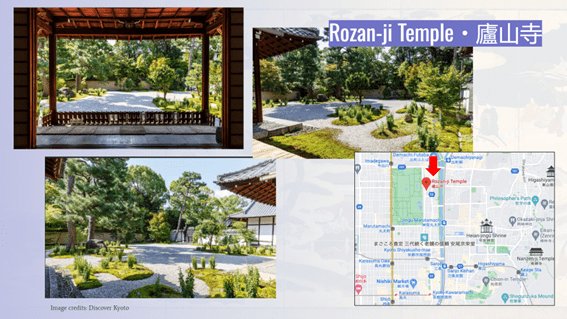
ROZAN-JI
Rozan-ji was built in 938 and is one of four temples with a private Buddhist chapel for the imperial family. It was relocated in 1571 to Teramachi, which is just east of Kyoto's Imperial Palace and it is most famous as the site where Murasaki Shikibu likely wrote The Tale of Genji, and is mentioned in her diary.
She was raised, lived her married life, and had a daughter in this mansion, as well as supposedly died here.
Because of its connection to The Tale of Genji, there are picture scrolls of Murasaki Shikibu’s writing and Genji illustrations, as well as shell-matching and other games played by Heian court ladies decorating the temple rooms.
The gardens at Rozan-ji are quite unique in that they feature moss-covered islands surrounded by white gravel in the shape of clouds.
The design is iterated in Japanese paintings and picture scrolls where gold clouds are used to span, obscure, or emphasize a space, and are often found in illustrations of The Tale of Genji embellished with gold foil or paint and are also known as “Genji clouds” ((源氏雲 / Genji-gumo).
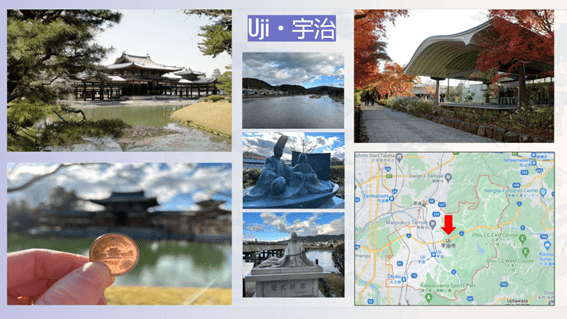
UJI BRIDGE, BYODOIN, MURASAKI SHIKIBU STATUE, UKIFUNE STATUE, AND THE TALE OF GENJI MUSEUM
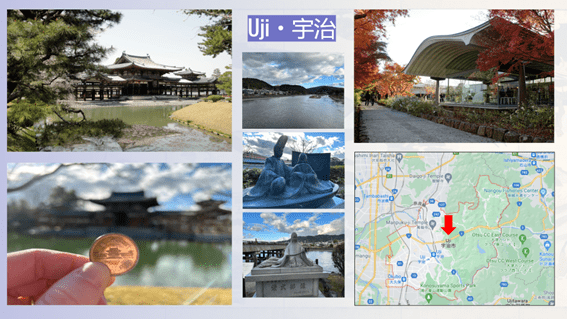
The second-to-last location I want to share with you today, is outside of Kyoto city, in Uji, where the last 10 chapters of the novel take place. These chapters follow Genji’s son, who falls in love with a maiden named Ukifune, who lives with her sisters and father outside the capital.
The Uji bridge, which (spoiler alert) Ukifune flings herself from, is flanked on both sides with statues, one of Murasaki Shikibu, which you see here, and on the other by a statue of Kaoru (her lover) and Ukifune.
Uji is also famous as producing the highest-quality green tea in Japan, home to the Byodo-in temple featured on the Japanese 10 yen coin, and The Tale of Genji museum, which was just recently renovated and reopened this spring.
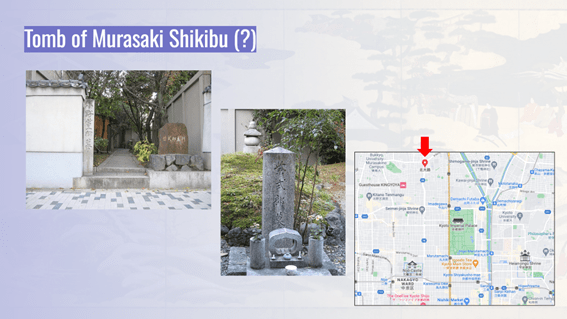
“TOMB” OF MURASAKI SHIKIBU
Finally, we come to Murasaki Shikibu's tomb which is supposedly located in Kyoto, just south of the Kitaoji-Horikawa intersection in a tiny nondescript plot near her principal residence at Rozan-ji. The stones here are modern, but classical literature aficionados will stop for a few minutes and pay their respects usually by lighting a candle.
I hope you enjoyed this mini-tour, and that your time in Kyoto leads you to even more places that feel straight out of The Tale of Genji…living literature waiting to be explored.
Related Posts
Small Steps to Big Connections
Written by Miranda, Program Coordinator Hello! My name is Miranda, and I am a Program Coordinator here at CIEE Kyoto. My first experience in Japan was as an exchange student... keep reading
SP26 OCBI-III Griffin Sibley
Written by Griffin Sibley When deciding where to study abroad, I wanted to challenge myself by living somewhere completely new. I also wanted a location that would give me the... keep reading
How Curiosity, Study Abroad, and the Silk Road Shaped My Journey
Written by Michiyo Ikemoto, Director of Operations What’s Your Aspiration? Why? There is a famous quote that asks: “If today were the last day of my life, would I want... keep reading