Seeing more: A road trip to Swakopmund, Namibia
Authored By:
Over the mid semester break at University of Botswana, I decided to go on a road trip with 11 other exchange students, several being from the United States, but there were others from Sweden, Germany, Switzerland, and Japan. I’m doing a semester abroad in Gaborone, Botswana with CIEE and this is my first time ever exploring Africa. The more time I spend here the more I realize that there’s so much to see and also so much to learn.
The first city we visited on our road trip was Swakopmund in Namibia. The drive from Gaborone to Swakopmund was honestly brutal — we were traveling from the far south-east corner of Botswana all the way across the entirety of Namibia to the western coast, where the land met the Atlantic ocean, in Swakopmund. We left at 3 AM lugging our baggage that weighed heavy on our shoulders and wondering what exactly this week would have in store for us. The night’s crisp air felt brimming with possibility and adventure.
Almost immediately we faced our first hurdle. Although our driver, Bethel, had made us more than aware that there wasn’t going to be much room in the van for bags so we should really pack light, it seems like we all had figured that was an exaggeration and interpreted “pack light” to best fit our own needs. So it didn’t come as a complete surprise that as soon as we started loading the bags into the van, sure enough, there wasn’t much room…at all. Gabby and I sat in the two seats directly behind the driver and watched in horror as all the bags got piled up in the empty space next to us. They piled higher and higher, and just when you thought they were all in, there were five more still to fit. There was almost a complete wall of bags trapping us into our seats and Gabby, who was sitting closer to the mountain, had her leg stuck underneath a bag for almost an hour. It was so ridiculous, we had to laugh. Somehow, we eventually managed to fit all of the luggage and all of our people. We scrunched up our legs into the most comfortable position possible and started our journey.
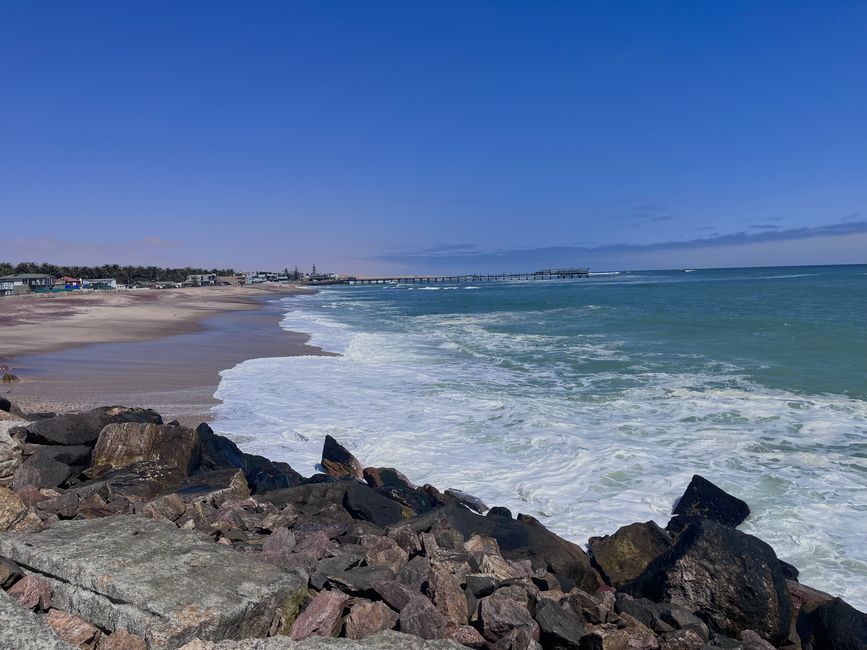
We arrived 22 hours later at the hostel. Whatever Google Maps tells you, take it with a grain of salt. If the drive says 10 hours, expect 15. If it says 16 hours, expect 22. There were a couple things that slowed us down along the way — like how every time the drivers stopped to get gas we all crawled our way out of the van to stretch our legs, use the bathroom, get water, and procrastinate getting back in the car. You really couldn’t blame us. The day was heating up and the AC in the van didn’t work, so heat was swirling thick in the vehicle’s air while our limbs grew sticky and our butts numbed. Then, there was the three hour pit stop at the border between Botswana and Namibia. That was quite a treat and didn’t at all make us want to pull our hair out. When we finally stepped out into Swakopmund, we were met with a blackened sky colored by stars and filled with the aroma of salty, ocean air. Skeleton Beach Backpackers, our hostel, was only a short walk down to the ocean. Exhausted, we breathed in the open breeze and went to sleep.
As soon as the sun came out and we started our day the next morning, it became clear to me that I would love this place. We walked down to the ocean and walked along the water, where shops and restaurants were scattered along the beach’s edge. It was blowing my mind that somehow we were still in Africa. The range of landscapes we had seen on the road contrasted so greatly from one another — Botswana’s sauna of a savannah seemed so far away from the chill I felt by Swakopmund’s coast. As we walked and browsed, I noticed pretty quickly that almost every business had a German name, complete with the Fraktur font I associate so closely with Germany. Not only this, but there were white people everywhere, which honestly felt jarring to see in southern Africa after I’d become so accustomed to light skin being a rare sight. Although I was a bit confused by the European influence, the Germans we were traveling with soon made things pretty clear — there’s a deep history of German colonization and genocide in Namibia that I had never once learned about, or even heard of before.
“Namibia: A timeline of Germany’s brutal colonial history,” an article published by Deutsche Welle, explains that Namibia was colonized by Germany in the 1880s, and was named German South West Africa. This was during the “Scramble for Africa,” where European powers began to claim areas of Africa that they wanted to control and colonize in the 19th and 20th centuries.. There was no consultation with the people of Namibia when this decision was made. While there was some discordance with the Namibian people and the new German government in power, the German Schutztruppe (the German colonial troops in Africa) was established to stifle this conflict. The German troops fought mercilessly with Herero rebels who would attack German settlers (the Herero being a Bantu speaking ethnic group in Southern Africa). It was established in 1904 that any Herero found in German occupied land would be killed. Slowly, the German colonies took over more and more of the natives’ land while massacring the Herero and Nama (an ethnic group of Southern Africa) people. They were forced into regions scarce of resources, leading to an enormous amount of people dying of hunger and thirst. The Herero and Nama rebellion was, for the most part, defeated by the German colonies, with remaining refugees being forced into concentration camps. One of these concentration camps was located in Swakopmund, Namibia.
According to an article by Forensic Architecture titled “German Colonial Genocide in Namibia,” Swakopmund was only established during German colonization as a seaport, becoming an important point of transport and development for the colony. The camp was essentially hidden from the rest of the town, located in a valley along the shore. There is little to no trace of it left — the area has instead been transformed into a residential neighborhood, with some luxury housing creeping into the edge of burial grounds where Namibian people now rest in unmarked graves. Between 2-3,000 people died in Swakopmund during the genocide, and almost 100,000 people were killed under German rule in Namibia. According to Deutsche Welle, this became recognized as the first genocide of the 20th century.
While walking around and browsing in the shops on our last day in Swakopmund, we came across the Marine Denkmal monument. On top of a large boulder stood a stony German soldier, rifle in hand, as one of his fellow comrades lay splayed out below him, deceased. The description was written in German, which one of the exchange students from Germany was able to translate for us. She was disturbed by what the text said, and explained that the monument was essentially memorializing German soldiers that had defeated a Herero rebellion. This was the first sign I had seen in Swakopmund that even acknowledged any sort of conflict between the German and Namibian people — and not only was the statue acknowledging the conflict, but it seemed to deny any wrongdoing by the Germans. It was eerie to see it displayed so publicly and proudly. There was red paint splattered over the soldiers and the boulder, like blood, which was done by protestors in 2017, The New York Times explained in an article titled “A Colonial-Era Wound Opens in Namibia.” We started walking away as a white family came up to look at the statue. A middle-aged man from the group posed in front of the monument with his thumb stuck straight up, as his wife snapped a photo of him.
I only learned about apartheid a year before coming to Botswana. It felt bonechilling to realize that this entire, huge, part of the world’s history had never been explained to me in school. It was a large reason why I actually decided to come here — there was this entire continent whose history and culture I’ve barely been exposed to and have never learned about before. If I had never traveled to Namibia, I’m not sure when I would have learned about the genocide there, or if I ever would have learned about it the country at all. I’m a Creative Writing major and Environmental Studies minor — history has honestly never been my forté. It has always felt out of my bounds and too expansive for me to ever catch up with.Being here is making me realize how important it is to be aware of the history from places all around the world. So many cultures have been pushed aside in the classroom and made to seem less important in the world’s storybook.
I loved visiting Namibia, and during every hot, sunny day in Gaborone I miss Swakopmund’s salty splashes. I remember how the waves would race one another to the shore, toppling over themselves: they were loud enough to drown out the beach and wide enough to feel eternal.
Related Posts
What I Packed to Study Abroad in Gaborone, Botswana
A master list of the items you should bring to study abroad in Gaborone, Botswana - including tips and tricks from my student perspective at the University of Botswana campus.
Arthur Pounds Join UB Marathon: Persevering through the finish line
Authored by: Ruby Pitinyane On October 13, 2024, Arthur Pounds (AJ) took part in the University of Botswana (UB) marathon at the UB Stadium, marking a significant milestone for him... keep reading
My Sense of Belonging in Botswana
By: Brianna James Even though my study abroad program concluded in May 2023, I am still brought to tears of reminiscence when I reflect on all those wonderful moments I... keep reading