Navigating Seoul: Tips for Using Public Transport as a First-Timer
Coming from a city that relies more on cars than public transportation, navigating around Seoul was one of the aspects of study abroad I was secretly pretty nervous about. Previously, my main experience with public transportation was the subway in New York City which is not the most user-friendly or easiest introduction.
T-Money vs. Climate Card
To access public transportation in South Korea requires either a T-Money card or a Climate card. If you have neither (lost your card, not enough money to refill it, etc) you can buy a one-use ticket at most train stations.
During CIEE orientation, I received a T-money card loaded with 10,000 KRW to get me started. The T-Money card is pay-as-you go and can be used nationwide. Simply go to any convenience store or train station to refill the card with cash! When you scan the card on the bus or train, a fare will be deducted from per-trip. Remember to scan your card on the way out as well, as it will grant you a free 30-minute transfer window!
- Pros: can be added to your digital wallet, more flexible in terms of where it can be used
- Cons: T-money can be refilled using a credit card using the machine at the train station, however, if you are using an international card, it may incur a service fee. Otherwise, you will have to use cash to top it off.
Alternatively, if you use public transport a lot within Seoul, the Climate Card might be a good option for you! Unlike the T-Money card, the Climate Card works by charging a flat fee for a set duration of time (30-day pass or short term tourist pass) and you can ride the subways and buses as much as you want within that time frame without worrying about the cost. The 30-day pass is 62,000 KRW to 70,000 KRW depending on what lines or modes of transport you may want to include. Physical Climate Cards are available for purchase at certain subway stations and nearby convenience stores. Once purchased, you may determine the start date within five days of charging.
- Pros: Less worries about re-charging or not having enough fare money, can be used mobile through the T-money app, unlimited rides within Seoul
- Cons: Excludes the Sinbundang Line, subway lines outside Seoul, intercity/airport buses, and non-Seoul-licensed buses, need to pay extra to access certain lines, buses, and other modes of transport like e-bikes.
Tip: Download the app “BuccaCheck” to check how much fare money is left on your card! Simply click “check balance”, scan your card at the top of your phone, and it will let you know how much fare money remains.
Buses
There are two main things I would keep in mind when taking the bus: a) what time of day is it? And b) what kind of bus?
- What time of day are you traveling?
The reason this matters is because this will determine how long you will have to wait for a bus with space, and how long it will take you to get to your destination once on the bus. During rush hour (7-9AM in the morning) and (5-7PM) at night it can be very difficult to get on a bus due to lack of space. Additionally, because buses are in the flow of traffic with all other buses and cars, they will be stuck like everyone else at that time.
- What bus is it?
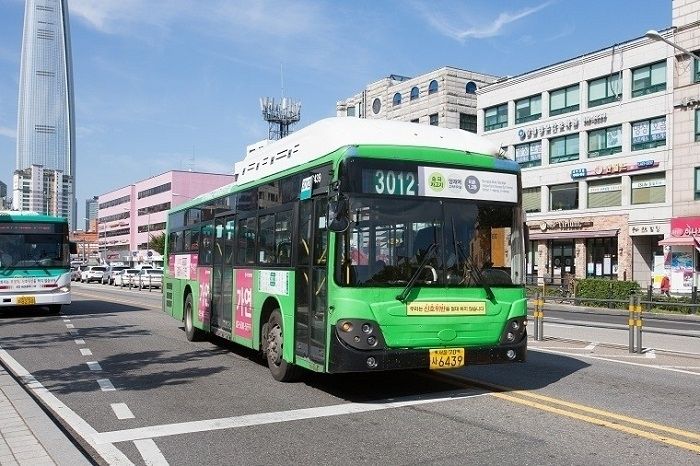
There are five different types of buses in Seoul. Blue (Mainline) Buses travel longer distances between the suburbs and downtown Seoul along major urban roads. The Green (Branch/Local) Buses connect residential areas to subway stations and Blue Bus routes. This also includes smaller "Maeul" (village) buses that serve narrow neighborhood streets. Because these buses tend to be smaller, during busy times you may have to pass-up the bus you want until one with room comes along. Because of their small size and tendency to go through small streets, you will get shaken around a lot- hold on tight! The Red (Rapid/Metropolitan) Buses are express commuter buses connecting central Seoul with surrounding cities in the Gyeonggi province.
The Yellow (Circular) Buses circle around central districts, connecting major business, shopping, and tourist centers. And finally, Owl (Late Night) Buses are marked with an "N" (e.g., N13, N37), and run from midnight to 4:00 AM.
In my opinion, taking a bus is the best option during non-rush hours and when traveling relatively close in Seoul or other cities.
Subway
The subway line was honestly less complicated than I anticipated! The trains operate from around 5:30 AM to midnight and connect to areas all over Seoul. Once you’re in your desired station, make sure to use your transportation card (Climate or T-money) or buy a ticket to swipe through the turnstile. Make sure to reference signs to make sure that the platform you’re on is going in the correct direction (even if the line is correct). Something I wasn’t anticipating was how expansive some of the stations are, so make sure to factor in longer transfer or exit times if you are heading somewhere in a hurry.
Generally the subways are quiet, clean, and efficient and a great way to get around the city during the day.
Reminder for both buses and subways: Tap your transport card when exiting! This will allow you a 30-minute free transfer window.
Taxi
Calling a taxi can be done either by hailing it on the street or calling it through an app like Kakao or Uber. I find that the taxis I have taken are typically between 10,000 KRW and 20,000 KRW in more tourist-y or high traffic areas (like airports). Taxis can really be divided into regular or deluxe taxis: regular taxis are silver or yellow while deluxe taxis are black and normally more expensive. If you are traveling late at night or early in the morning, a taxi is the move, however, I would avoid them during rush hour.
Maps
The easiest way to navigate in South Korea is using either Naver Map or KakaoMap. Google Maps and Apple Maps do not work as well and are not as updated. Personally, I’m more familiar with Naver Map! Through Naver Map you can also discover/ search for restaurants, cafes, shops, etc, in addition to doing navigation. The platform is pretty English friendly if you’re not that familiar with Korean, however, sometimes restaurants or shops will only show up if you type the Hangul.
Related Posts
Why I Chose South Korea: Starting My Study Abroad Journey at Yonsei University
Hi everyone! My name is Adiba Anjum, and I’m currently studying abroad in Seoul, South Korea, at Yonsei University through CIEE. I’m originally a student at the University of Illinois... keep reading
A Weekend Getaway in Jeju
This past weekend, my friends and I booked a last-minute four-day trip to Jeju. We mostly just made sure our flight times and Airbnb were set before leaving. The flight... keep reading
A Sunday in Korea Gone Wrong?!
What started as a normal Sunday in Seoul quickly turned into a day that didn’t go quite as planned. Between exploring the city and dealing with unexpected moments, it became one of those days that made me feel like I was truly experiencing life abroad.