CIEE Welcomes Knowledge Without Borders Fellows to Berlin
Authored By:
Four U.S. college students will explore Germany’s history, democratic memory, and the role of international education in understanding today’s world
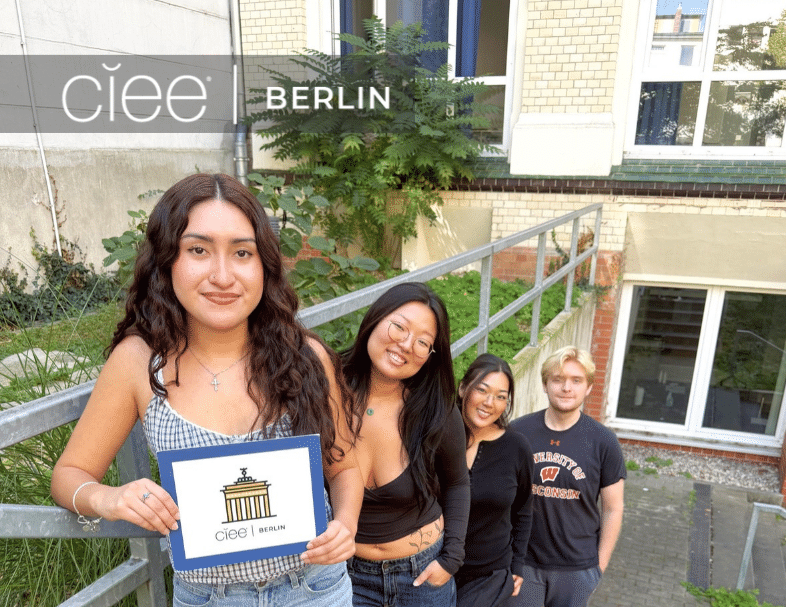
Last week, CIEE welcomed four U.S. college students to Berlin as the inaugural Knowledge Without Borders: Democracy and Memory Fellows, recipients of a fellowship established through the generosity of Karen Collias, Ph.D., founder of Knowledge Without Borders (KWB).
Collias’ $55,000 gift provides scholarships for four first-generation, Pell-eligible undergraduate students to participate in CIEE’s Berlin Open Campus program. Through coursework, site visits, and conversations with historians, civic leaders, and other experts, the Fellows will explore Germany’s history, including the rise of Nazism and the Holocaust, and examine how historical memory has shaped German society since 1945.
The Fellows arrive in Berlin at a particularly timely moment. Recent state elections in Germany have renewed public discussion about history, identity, civic education, and democratic institutions, adding a contemporary dimension to the questions the students will explore throughout their semester.
At the heart of the fellowship is a question that connects Germany’s history with broader questions facing societies today: What happens when subsequent generations begin to challenge the memory culture on which a democratic order was partly built?
“These developments make the Fellows’ experience especially meaningful,” said Karen Collias, Ph.D., founder of Knowledge Without Borders. “They will have the opportunity to study how Germany has confronted its history while also considering how societies remember, interpret and learn from the past.”
The fellowship will encourage students to consider these questions from multiple perspectives and connect their experience in Germany with their own communities and experiences in the United States.
“I am incredibly grateful for this scholarship and the opportunity to study German politics, democracy, and history while living in Germany,” said Carter Maki, KWB Fellow from the University of Wisconsin. “Being here allows me to experience firsthand how Germany has emerged from its complex history to become a leader in the European Union and the world. At a time when democracy is being tested around the globe, studying these issues while immersing myself in the culture and political landscape has given me insights I could never gain from a classroom alone.”
“International education gives students the opportunity to engage directly with the places, people and perspectives that bring history to life,” said James P. Pellow, Ed.D., President and CEO of CIEE. “We are proud to support these students as they explore important questions about history, culture and civic life through firsthand experience.”