
Liberal Arts Language Immersion


Unique Experiences
Improve your Spanish
by choosing from Universidad de Seville’s Cursos Concertados course offerings alongside other international students
Learn about Spanish culture
and create friendships living with a homestay family or at a dorm along with other local Spanish students
Enjoy living in a cosmopolitan city
with an amazing sociocultural nightlife that will make you fall in love with Seville and its way of living

Your Destination
Seville is Spain’s charming city where Spanish culture and history come alive, creating the perfect environment for language immersion and cultural exploration. Whether you're practicing Spanish with locals in bustling markets, engaging in lively discussions at a traditional tapas bar, or exploring the historic streets of the Santa Cruz neighborhood, every experience deepens your connection to the language and culture. With a perfect blend of history, modern energy, and artistic expression, Seville is the perfect place to study abroad.

Program Highlights
- Academic Courses: Choose from CIEE courses and host institution courses that align with your academic major.
- Optional Internship Placements: Enhance your program with an optional for-credit internship that aligns with your career aspirations.
- Immersive Experiences: Participate in activities, excursions, study tours, and more that showcase your host city's culture, values, and local art, film, music, cuisine, and sports scenes.
- Cultural Projects: Volunteer with members of the local community, join student clubs to socialize with your peers, and attend local workshops and events to get to know your host city.

Excursions & Activities
CIEE’s excursions and cultural activities in Seville will open doors for you to explore Spain’s rich diversity, language, culture, history, and timeless beauty in ways that will enhance your time abroad.
Samples of past excursions and activities:
- Engage in fun sports activities and workshops such as bike tours, wine tastings, cooking, flamenco, ceramics classes, and many more
- Explore beyond Seville and participate in overnights, day trips, and excursions to discover other Spanish cities in the region of Andalucía
- Soak up Spanish culture through neighborhood visits to some of the most emblematic locations, such as Triana and Santa Cruz
Please note: Activities are based on past programs and subject to change at CIEE's discretion to adapt to local circumstances and participant feedback. Our goal when arranging activities is always to enhance your experience.
Program Blogs

Semester in Seville, the Realities of a Gift of a Lifetime
By: Caroline Parker Hello readers! My name is Caroline Parker, and I was a Liberal Arts for the semester with CIEE Sevilla. Studying abroad in Sevilla has truly been a... keep reading
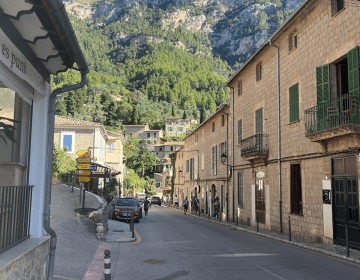
Traveling While Abroad While Studying in Europe
By: Alex Smith The first thing you might think when you get that acceptance letter to your study abroad program (especially Europe) is of all the places you want to... keep reading

How to Decide Which Classes to Take for Seville Liberal Arts
By: Amelia Asfaw The Liberal Arts program in Sevilla, Spain offers all Spanish classes taught at both the CIEE center and at the University of Sevilla. And at the University... keep reading
Housing & Meals
Housing
CIEE Seville offers two housing options to meet the needs of all students who want to comfortably enjoy the city while living in a culturally immersive environment: Either living with families in homestays or with other local and international students in a residence hall. All housing options have convenient access to public transportation.
Standard Housing: Includes a single room at a homestay, or a double occupancy room at a residence hall located within a 45-minute commute of CIEE Seville. Commute time from housing to host institution campuses may vary.
- Homestay: Homestays feature a kitchen, living room, and bathroom shared with a host family.
- Residence Hall: Residence halls have kitchen access, shared laundry facilities, and common spaces.
Select Housing: Includes a single room (shared bathroom and kitchenette with another CIEE participant) in a residence hall located under 30 minutes from CIEE Seville or a single studio (including private bathroom, kitchen, and laundry facilities) in a residence hall within 45 minutes of CIEE Seville. Commute time from housing to host institution campuses may vary. Select housing requires an additional fee.
A note: The default criterion to assign housing is first-come, first-served; however, other factors may also be considered. If we cannot accommodate your first housing choice, we'll let you know before you arrive. Non-standard housing options require an additional fee that can be found in the program Dates and Fees.
Meals
Homestays: Three meals per day are included.
Residence Halls: Meals are not included. Students have access to the studio apartment kitchens.


Academics
CIEE Seville: Study in the heart of Seville in a beautifully renovated 18th-century palace in close proximity to shops, markets, restaurants, cafés, Catedral de Sevilla, the Royal Alcázar of Seville, and other important monuments. CIEE Seville features six classrooms, a library, an academic advising office, a student life office, and a computer lab.
Universidad de Sevilla has been one of Spain’s leading institutions of higher learning since the 16th century and hosts some 75,000 students. Its many schools, departments, and institutes serve the educational needs of Spain’s most populous region.
Universidad Pablo de Olavide (UPO) is the second-largest state university in Seville. Its 345-acre campus is 30 minutes from the center of the city. UPO offers undergraduate and graduate programs in traditional majors, as well as other areas, from biotechnology to translation. Modern facilities include campus-wide Internet access, sports facilities, science labs, and more.
EUSA (Estudios Universitarios Superiores de Andalucía) University Centre is a Spanish private university center founded in 1961 and affiliated with the University of Seville since 1996. Their official undergraduate degrees include Audiovisual Communication, Journalism, Advertising and Public Relations, and Tourism. EUSA is one of the educational components that constitute the Campus Formativo of the Chamber of Commerce of Seville, a unique configuration located in the heart of Seville which has catered to the learning needs of more than 55,000 national and international students.
Arizona State University (ASU): Brought to you by CIEE in partnership with ASU, enhance your international coursework with online classes that align with your degree requirements. ASU offers thousands of online courses in asynchronous 7.5-week sessions that fit within the CIEE academic calendar.
Course Information
First-year courses at the University of Seville are not available to international students.
Academic Projects
- Students applying for an Academic Project are required to submit additional materials during the course selection process.
- Academic Projects are only available in Spanish to this program.
Grades Notes
- Grades from Seville may take longer than 12 weeks to process due to host university timelines. Please contact CIEE only if your grades are still missing after that period.
- For Direct Matriculation courses at host institutions, you must remain in Seville until you complete your exams. Official exam periods are Fall (January) and Spring (June). Some professors may allow early exams in December or May, but this is at their discretion and must be requested and confirmed individually during the CIEE add/drop period at the start of the term. Because exam schedules cannot be confirmed before arrival, if you plan to leave as soon as finals end, purchase a flexible ticket or one with a low change fee.
Academic Projects
Business, Economics, Management, and Marketing
Communication, Journalism, and Media
History, Philosophy, Religion
Languages and Cultural Studies
Literature, Linguistics, and Writing
Social Sciences
Visual and Performing Arts
Agriculture
Academic Projects
Business, Economics, Management, and Marketing
Communication, Journalism, and Media
History, Philosophy, Religion
Languages and Cultural Studies
Literature, Linguistics, and Writing
Social Sciences
Visual and Performing Arts
Agriculture
Academic Projects
Business, Economics, Management, and Marketing
Communication, Journalism, and Media
Health Professions and Related Programs
History, Philosophy, Religion
Languages and Cultural Studies
Literature, Linguistics, and Writing
Psychology
Social Sciences
Visual and Performing Arts
Agriculture
Course offerings may vary from semester to semester. Here is a sample of courses that may be offered:
UNIVERSITY OF SEVILLE (US)
Course and syllabi finder, for courses in Spanish
UNIVERSIDAD PABLO DE OLAVIDE (UPO)
Course and syllabi finder, for courses in Spanish
CURSOS CONCERTADOS COURSES
Cursos Concertados are taught at the University of Seville (Schools of Philology, Geography, and History) exclusively for international students.
Courses in Spanish
- DE USCC-FA-02: Contrastive Grammar: Spanish-English
- DE USCC-FA-03: Corrective Phonetics and Conversation
- DE USCC-FA-09: Contemporary Spanish Cinema
- DE USCC-FA-25: Literature and Cuisine: Read, Write, Cook and Eat
- DE USCC-FA-30: Introduction to Translation: Culture, Vocabulary and Process
- DE USCC-FA-31: Progressive Spanish For English-Speaking Students
- DE USCC-FA-37: Painting in Literary Seville
- DE USCC-FA-43: Teaching English To Spanish Students: Methodology And Practice
- DE USCC-FA-44: The Social Psychology of Language Learning
- DE USCC-GA-01 : Culture and Society in Present-day Spain
- DE USCC-GA-09: The Historical Projection of the Three Cultures: Christians, Moslems and Jews
- DE USCC-GA-15: Political Transition and Democracy in Spain (1975-2000)
- DE USCC-GA-19: Photography: An Approach to History and Contemporary Practice
- DE USCC-GA-20: Economy, Society and the Environment in Spain
- DE USCC-GA-21: Cuisine Culture in Spain
- DE USCC-GA-22: Wine in Spain: History, Culture, and Economics
- DE USCC-GA-27: Introduction to Flamenco through Rhythm, Dance, Singing, and Guitar
EUSA COURSES
EUSA courses are part of a bachelor’s degree program for local students (including Erasmus students).
Courses in Spanish
DE EUSA 5370011: Advertising Creativity
DE EUSA 5370052: Advertising in the Social and Economic Sector
DE EUSA 5370012: Advertising Strategy
DE EUSA 5370004: Advertising Theory and Structure
DE EUSA 5370021: Analysis of Advertising Discourse
DE EUSA 5380037: Analysis of Journalistic Discourse
DE EUSA 5370022: Artistic Context of Advertising
DE EUSA 5390039: Audiovisual Cultural Industries
DE EUSA 5390058: Audiovisual Mise en Scene
DE EUSA 5390024: Audiovisual Narrative
DE EUSA 5390011: Audiovisual Scripting
DE EUSA 5370014: Audiovisual Media Technology
DE EUSA 5390015: Audiovisual Media Technology II
DE EUSA 5370056: Brand Management
DE EUSA 5390036: Comic Strips and Cartoons
DE EUSA 5380021: Communication Departments
DE EUSA 5380001: Communication Skills in Spanish
DE EUSA 5370058: Communication Theory
DE EUSA 5370059: Consumption Digital Theory
DE EUSA 5390014: Contemporary Aesthetic Movements
DE EUSA 5390028: Creative Writing
DE EUSA 5380038: Cyberculture
DE EUSA 5390021: Digital Audio Editing and Post Production
DE EUSA 5370038: Discourse Strategies of Verbal Communication in Advertising
DE EUSA 5370001: Economics Applied to Advertising
DE EUSA 5370037: Ethics and Social Responsibility in Advertising
DE EUSA 5390052: Film Making I – Basics
DE EUSA 5390059: Film Making III – Digital Video and Postproduction
DE EUSA 5390068: Game Design and Ludonarrative
DE EUSA 5390001: History of Contemporary Culture
DE EUSA 5390004: Image Theory
DE EUSA 5370025: Image Theory
DE EUSA 5380011: Information Law
DE EUSA 5380005: International Relations
DE EUSA 5380003: Introduction to Applied Economics
DE EUSA 5380004: Introduction to Sociology
DE EUSA 5380012: Journalism Documentation
DE EUSA 5380015: Journalism Theory
DE EUSA 5390003: Literary Trends in Contemporary Culture
DE EUSA 5380052: Multimedia Journalism & Digital Graphic Design
DE EUSA 5390040: Music and Mass Culture
DE EUSA 5380028: News Reporting – Press
DE EUSA 5380043: Online News
DE EUSA 5380024: Organisation and Management of Journalism Businesses
DE EUSA 5390035: Peripheral Film Industries
DE EUSA 5370023: Planning and Management of Advertising Media
DE EUSA 5380026: Political and Economic Journalism
DE EUSA 5370036: Political Communication
DE EUSA 5370005: PR Theory and Structure
DE EUSA 5390025: Production and Audiovisual Business II
DE EUSA 5380023: Public Opinion
DE EUSA 5370024: Public Relations Programming and Techniques
DE EUSA 5370013: Quantitative Social Research Methods and Techniques
DE EUSA 5370061: Sales Promotion & Consumption
DE EUSA 5380042: Social and Educational Journalism
DE EUSA 5380002: Social History of Communication
DE EUSA 5370002: Spanish Language & Advertising: Language & Communication Skills
DE EUSA 5390013: Spanish Language: Language Skills and Communication Competencies
DE EUSA 5380014: Technology & Design of Written Information
DE EUSA 5370041: Theory and History of Advertising Design
DE EUSA 5390067: Theory and Techniques of Documentary Film and Audiovisual Advertising
DE EUSA 5370027: Theory and Technology of Advertising Photograph
DE EUSA 5390005: Theory of Advertising and Public Relations
DE EUSA 5380041: Travel Journalism
DE EUSA 5380013: Universal History of Journalism
DE EUSA 5390002: Written Information Technologies
- DE EUSA 5590042: Total Quality Management for Tourism
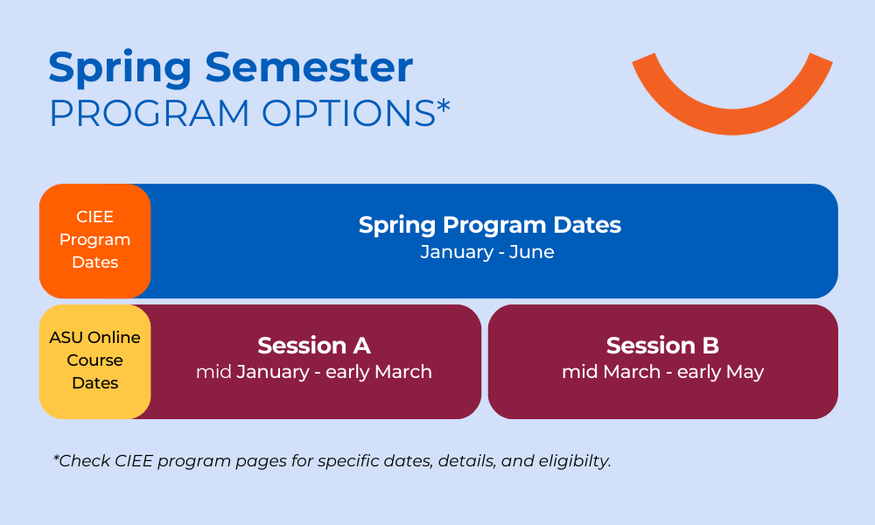
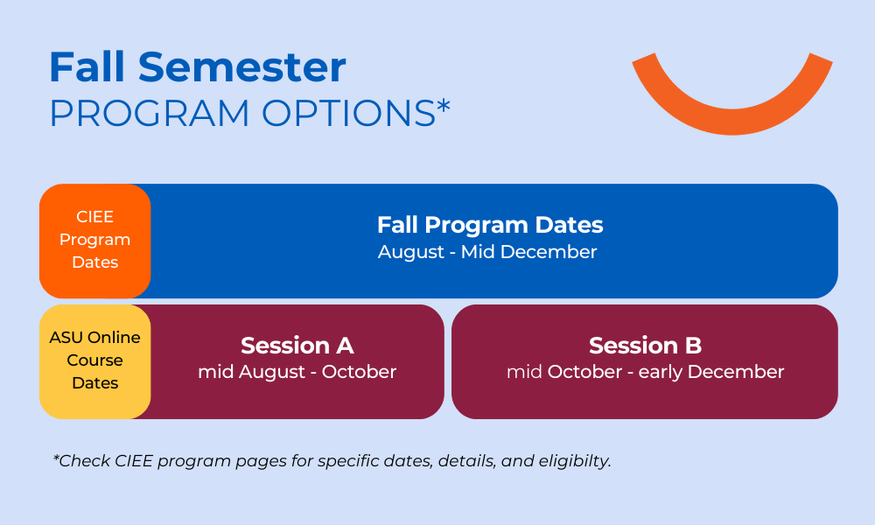
CIEE proudly partners with ASU to deliver asynchronous, 100% online coursework that aligns with your degree requirements from anywhere you study abroad.
CIEE and ASU offer courses online per program eligibility, at no additional charge. Be sure to review online courses with your home school advisor.
Check the CIEE Program Dates and ASU start dates below to maximize course options within your program!
Search ASU Online Courses BROWSE FAQs for more INFO
Note: This course listing is for informational purposes only and does not constitute a contract between CIEE and any applicant, student, institution, or other party. The courses, as described, may be subject to change as a result of ongoing curricular revisions, assignment of lecturers and teaching staff, and program development. Courses may be canceled due to insufficient enrollment.
"(GI)" denotes courses that originated at CIEE's Global Institutes and that are offered at multiple CIEE sites.
Scholarships & Grants
CIEE offers scholarships and grants annually to help students like you make your study abroad dream a reality.
Students who apply to this program are eligible for the following scholarships and grants:
- Ping Scholarships for Academic Excellence
- Global Access Initiative (GAIN) Travel Grants
- Stohl International Undergraduate Research Scholarships
- CIEE Gilman Go Global Grant
- Global Access Initiative (GAIN) Scholars Grants
To be considered, submit the CIEE Scholarships & Grants application within your CIEE program application.
Dates & Fees
You get more for every dollar when you study abroad with CIEE, because our high-quality programs include everything from excursions to insurance. There are no hidden charges, and no disappointing surprises when you arrive.
Program |
Application Due |
Start Date |
End Date |
Fees & Housing |
|---|---|---|---|---|
| Program Spring 2027 17 weeks | Application Due Deadline Passed | Start Date | End Date | Fees & Housing $20,450 |
| Program Fall 2027 14 weeks | Start Date * | End Date * | Fees & Housing $20,450 | |
| Program Academic year 2027-2028 36 weeks | Start Date * | End Date * | ||
| Program Spring 2028 17 weeks | Start Date * | End Date * | ||
| Program Fall 2026 15 weeks | Application Due Deadline Passed | Start Date | End Date | Fees & Housing $19,950 |
| Program Academic year 2026-2027 37 weeks | Application Due Deadline Passed | Start Date | End Date | Fees & Housing $39,375 |
*Dates for this program are provided as tentative dates. Please consult with your study abroad advisor to confirm dates before purchasing your flights.
To help you budget, keep in mind that students are responsible for the cost of international airfare, local transportation, books and supplies, visas, and personal expenses. In addition, your college or university may charge additional fees for study abroad, or may require you to receive a transcript via CIEE's School of Record, which carries an additional fee of $500.
Program Fees
CIEE offers the most student support of any provider in its program fee, including an airport greeting, full-time leadership and support, orientation, cultural activities, local excursions, pre-departure advising, and CIEE iNext travel protection with benefits.
| Participation Confirmation | $500 * |
| Educational Costs | $15,006 ** |
| Housing | $4,750 *** |
| Insurance | $194 |
| Total Fees | $20,450 |
Optional Housing
CIEE accommodation options are detailed in the Housing section. Based on availability, Select or Select Plus Housing can be chosen during the application process for an additional fee. Housing is assigned on a first-come, first-served basis; however, other factors may also be considered.
| Select Housing Fee | $850 |
Financial Aid
CIEE offers the most grants and scholarships of any study abroad organization, including $8 million/year in travel grants, merit-based scholarships, institutional grants, and Gilman Go Global Grants.
Estimated Costs
Students are responsible and manage costs related to travel, meals, books, and personal expenses. Below are estimates for consideration.
| Meals not included in program fee | $520 † |
| International Airfare | $1,250 †† |
| Local Transportation | $160 ††† |
| Books & Supplies | $60 |
| Visa Fees | $160 |
| Potential travel to consulate for visa | $500 |
| Personal expenses | $1,016 †††† |
| Total Costs | $3,666 |
*non-refundable fee
**Direct cost of education charged uniformly to all students
***Housing fees listed are for financial aid purposes only and should not be considered a basis for calculation of refunds.
†For students in homestays, families provide all meals (breakfast, lunch and dinner). The listed estimated cost is optional for dining out once per week ($520). Budget more money if you plan on eating out regularly. For students in residence halls/apartments, you should budget approx. $266 per month for groceries if you plan on making your own meals, and more if you plan on eating out regularly.
††round-trip based on U.S. East Coast departure
†††Transportation card $40 per month.
††††Personal expenses may include but are not limited to the following: taxis, social activities and entertainment, toiletries, cell phone (low-cost SIM card with a 30GB-50GB data plan). Does not include personal travel.
Program Fees
CIEE offers the most student support of any provider in its program fee, including an airport greeting, full-time leadership and support, orientation, cultural activities, local excursions, pre-departure advising, and CIEE iNext travel protection with benefits.
| Participation Confirmation | $500 * |
| Educational Costs | $15,006 ** |
| Housing | $4,750 *** |
| Insurance | $194 |
| Total Fees | $20,450 |
Financial Aid
CIEE offers the most grants and scholarships of any study abroad organization, including $8 million/year in travel grants, merit-based scholarships, institutional grants, and Gilman Go Global Grants.
Estimated Costs
Students are responsible and manage costs related to travel, meals, books, and personal expenses. Below are estimates for consideration.
| Meals not included in program fee | $429 † |
| International Airfare | $1,250 †† |
| Local Transportation | $160 ††† |
| Books & Supplies | $60 |
| Visa Fees | $160 |
| Potential travel to consulate for visa | $500 |
| Personal expenses | $996 †††† |
| Total Costs | $3,555 |
*non-refundable fee
**Direct cost of education charged uniformly to all students
***Housing fees listed are for financial aid purposes only and should not be considered a basis for calculation of refunds.
†For students in homestays, families provide all meals (breakfast, lunch and dinner). The listed estimated cost is optional for dining out once per week ($429). Budget more money if you plan on eating out regularly. For students in residence halls/apartments, you should budget approx. $266 per month for groceries if you plan on making your own meals, and more if you plan on eating out regularly.
††round-trip based on U.S. East Coast departure
†††Transportation card $40 per month.
††††Personal expenses may include but are not limited to the following: taxis, social activities and entertainment, toiletries, cell phone (low-cost SIM card with a 30GB-50GB data plan). Does not include personal travel.
Program Fees
CIEE offers the most student support of any provider in its program fee, including an airport greeting, full-time leadership and support, orientation, cultural activities, local excursions, pre-departure advising, and CIEE iNext travel protection with benefits.
Financial Aid
CIEE offers the most grants and scholarships of any study abroad organization, including $8 million/year in travel grants, merit-based scholarships, institutional grants, and Gilman Go Global Grants.
Estimated Costs
Students are responsible and manage costs related to travel, meals, books, and personal expenses. Below are estimates for consideration.
Program Fees
CIEE offers the most student support of any provider in its program fee, including an airport greeting, full-time leadership and support, orientation, cultural activities, local excursions, pre-departure advising, and CIEE iNext travel protection with benefits.
Financial Aid
CIEE offers the most grants and scholarships of any study abroad organization, including $8 million/year in travel grants, merit-based scholarships, institutional grants, and Gilman Go Global Grants.
Estimated Costs
Students are responsible and manage costs related to travel, meals, books, and personal expenses. Below are estimates for consideration.
Program Fees
CIEE offers the most student support of any provider in its program fee, including an airport greeting, full-time leadership and support, orientation, cultural activities, local excursions, pre-departure advising, and CIEE iNext travel protection with benefits.
| Participation Confirmation | $300 * |
| Educational Costs | $14,706 ** |
| Housing | $4,750 *** |
| Insurance | $194 |
| Total Fees | $19,950 |
Optional Housing
CIEE accommodation options are detailed in the Housing section. Based on availability, Select or Select Plus Housing can be chosen during the application process for an additional fee. Housing is assigned on a first-come, first-served basis; however, other factors may also be considered.
| Select Housing Fee | $750 |
Financial Aid
CIEE offers the most grants and scholarships of any study abroad organization, including $8 million/year in travel grants, merit-based scholarships, institutional grants, and Gilman Go Global Grants.
Estimated Costs
Students are responsible and manage costs related to travel, meals, books, and personal expenses. Below are estimates for consideration.
| Meals not included in program fee | $0 † |
| International Airfare | $1,250 †† |
| Local Transportation | $160 ††† |
| Books & Supplies | $60 |
| Visa Fees | $160 |
| Potential travel to consulate for visa | $500 |
| Personal expenses | $210 †††† |
| Total Costs | $2,340 |
*non-refundable fee
**Direct cost of education charged uniformly to all students
***Housing fees listed are for financial aid purposes only and should not be considered a basis for calculation of refunds.
†For students in homestays, families provide all meals (breakfast, lunch and dinner). For students in residence halls/apartments, you should budget approx. $265 per month for groceries if you plan on making your own meals, and more if you plan on eating out regularly.
††round-trip based on U.S. East Coast departure
†††Transportation card $40 per month.
††††$100 emergency fund + cell phone expense (low-cost SIM card with a 30GB-50GB data plan) + toiletries
Program Fees
CIEE offers the most student support of any provider in its program fee, including an airport greeting, full-time leadership and support, orientation, cultural activities, local excursions, pre-departure advising, and CIEE iNext travel protection with benefits.
| Participation Confirmation | $300 * |
| Educational Costs | $29,381 ** |
| Housing | $9,500 *** |
| Insurance | $194 |
| Total Fees | $39,375 |
Optional Housing
CIEE accommodation options are detailed in the Housing section. Based on availability, Select or Select Plus Housing can be chosen during the application process for an additional fee. Housing is assigned on a first-come, first-served basis; however, other factors may also be considered.
| Select Housing Fee | $750 |
Financial Aid
CIEE offers the most grants and scholarships of any study abroad organization, including $8 million/year in travel grants, merit-based scholarships, institutional grants, and Gilman Go Global Grants.
Estimated Costs
Students are responsible and manage costs related to travel, meals, books, and personal expenses. Below are estimates for consideration.
| Meals not included in program fee | $0 † |
| International Airfare | $1,250 †† |
| Local Transportation | $160 ††† |
| Books & Supplies | $60 |
| Visa Fees | $160 |
| Potential travel to consulate for visa | $500 |
| Personal expenses | $210 †††† |
| Total Costs | $2,340 |
*non-refundable fee
**Direct cost of education charged uniformly to all students
***Housing fees listed are for financial aid purposes only and should not be considered a basis for calculation of refunds.
†For students in homestays, families provide all meals (breakfast, lunch and dinner). For students in residence halls/apartments, you should budget approx. $265 per month for groceries if you plan on making your own meals, and more if you plan on eating out regularly.
††round-trip based on U.S. East Coast departure
†††Transportation card $40 per month.
††††$100 emergency fund + cell phone expense (low-cost SIM card with a 30GB-50GB data plan) + toiletries
What's Included
Tuition
Housing
Pre-departure Advising
Advising before you depart to set goals and answer questions
Optional on-site airport meet-and-greet
Orientation
Introduction to your program plus practical information about living in your host city
On-site Staff
Full-time program leadership and support in your city
Cultural and/or Co-curricular Activities
Excursions and/or Study Tours
Travel Protection
CIEE iNext travel protection
24/7 emergency on-site support
Our Staff

José Luis Martinez
Academic Director
José Luis Martinez (Juli) has a B.A. in Hispanic Philology and an M.A. in Spanish Literature (Theater) from the Universidad de Seville. He has been working with CIEE since 2002.

María Montes de Oca
Director of Student Life
María has been working at CIEE since 2007. She studied Journalism and Translation Studies (French and Italian) at University of Granada, and obtained a Masters degree in European Studies. Having studied and worked abroad herself, she does her best to help program participants to have an enjoyable and rewarding semester in Spain.

Virginia Neira
Program Manager
Born and raised in Seville, Virginia has maintained a strong connection with her hometown throughout her professional life. In 2006, she began her journey at CIEE Seville. Virginia is known for her passion for working with students from diverse cultures and nationalities, reflecting her interest in intercultural interaction and global learning.
Get Started
1
2
Connect With Your Campus Study Abroad Office
Share your plans and confirm you're on track to meet all required steps to go abroad.
3
Contact Us
Send us an email if you still have questions or need information about applying to this program.
You might also like

- Barcelona, Spain
- Study Program
...for 1, 2, or 3 term blocks!

- Madrid, Spain
- Study Program
- Part-Time Internship
...for 1, 2, or 3 term blocks!

- Seville, Spain
- Study Program
...for 1, 2, or 3 term blocks!