
Arts + Sciences at University of Cape Town
AACSB Accredited






Unique Experiences
Connect with South African students
and build meaningful friendships through cultural exchanges, collaborative cooking sessions, and late-night conversations
Serve Cape Town’s people in need
as you assist with urban garden projects or participate in community-led programs that address social challenges
Explore natural beauty and outdoor fun
with Table Mountain as your backdrop, pristine beaches just minutes away, and weekend adventures like hiking or wine tasting

Your Destination
Cape Town is South Africa's stunning coastal city, celebrated for its natural beauty, vibrant arts scene, and cutting-edge advancements in science and sustainability. The city seamlessly blends African culture with modern innovation, offering world-class museums, historic landmarks like Robben Island, and breathtaking natural scenery. Whether you are studying the arts or sciences, Cape Town provides top-tier academics and a thriving creative industry. With its scenic coastline, diverse cuisine, outdoor adventures, and vibrant urban life, Cape Town is the perfect place to study abroad.

Program Highlights
- Academic Courses: Choose from host institution courses and online courses delivered by CIEE’s global partner, ASU, that align with your academic major.
- Immersive Experiences: Participate in activities, excursions, study tours, and more that showcase your host city's culture, values, and local art, film, music, cuisine, and sports scenes.
- Cultural Projects: Volunteer with members of the local community, join university clubs to socialize with your peers, and attend local workshops and events to get to know your host city.

Excursions & Activities
CIEE’s excursions and cultural activities in Cape Town will open doors for you to explore South Africa's rich diversity, language, culture, history, and timeless beauty in ways that will enhance your time abroad.
Samples of past excursions and activities:
- Explore Cape Town's museums like the Iziko Slave Lodge, Robben Island, and District Six Museum, each offering a unique perspective on the country's journey
- Take a tour of Bo-Kaap or participate in a cooking course at Eziko, where you'll learn about the vibrant traditions and cultural significance of its diverse cuisine
- Get creative and active by testing your skills in surfing and learning how to move to the rhythms of African dance
Please note: Activities are based on past programs and subject to change at CIEE's discretion to adapt to local circumstances and participant feedback. Our goal when arranging activities is always to enhance your experience.
Program Blogs

EAT, DRINK, EXPLORE: CAPE TOWN
BEST FOOD TO EAT IN CAPE TOWN If you’re looking to pinpoint South Africa’s national dish, here’s a helpful tip: there isn’t one. Cape Town’s multi-cultural heritage boasts British, French... keep reading
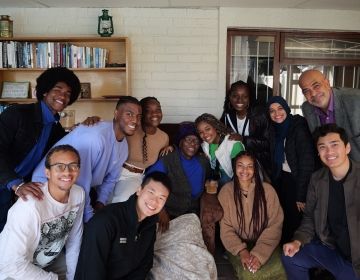
Reflecting on South Africa as a Frederick Douglass Global Fellow
By: Sam Li Stepping off the plane in Cape Town felt like stepping into a whirlwind of vibrant energy, complex history, and breathtaking landscapes. This wasn't just any summer adventure... keep reading

Equestrian Getaway in Cape Town
Authored by Haroni Sahilu (she/her) (Haroni is a rising senior at Arizona State University, majoring in Philosophy and Justice Studies. During her time in Cape Town, she hopes to aid... keep reading
Housing & Meals
Housing
CIEE Cape Town offers comfortable, fully furnished shared accommodation conveniently located within easy reach of CIEE Cape Town, public transportation, shops, and other essential amenities. Each apartment includes a fully equipped kitchen, Wi-Fi access, and all necessary cookware, cutlery, crockery, and bed linens. Students are required to bring their own towels.
Housing is designed to foster both social interaction and academic focus. Shared communal spaces provide opportunities to connect with fellow participants and local South African students, while quieter areas are available for individual study or group work.
Standard Housing: Standard housing includes triple or double accommodation in a shared apartment. In all accommodation types, each student will have their own bedroom. All apartments are located within a 25-minute commute of CIEE Cape Town, offering a convenient balance between independence and accessibility.
- Double/Triple Accommodation: The double accommodation includes a shared kitchen and bathroom; the triple space apartment includes a shared kitchen, lounge, and bathroom area.
A note: The default criterion to assign housing is first-come, first-served; however, other factors may also be considered. If we cannot accommodate your first housing choice, we'll let you know before you arrive. Non-standard housing options require an additional fee that can be found in the program Dates and Fees.
Meals
Students are responsible for all meals. They can cook in the communal kitchen or eat out.







Academics
CIEE Cape Town: Study in the vibrant student-friendly suburb of Rondebosch near central Cape Town. CIEE Cape Town boasts two main classrooms, a small meeting room, a student lounge, a student life office, and an academic advising office.
University of Cape Town (UCT): Established as South African College in 1829, UCT is internationally recognized as the top-ranked African research university. In 2022, UCT ranked 160th in the world (QS rankings). The UCT campus has beautiful grounds and attractive facilities which include a range of commercial, medical, recreational, and sporting facilities.
Arizona State University (ASU): Brought to you by CIEE in partnership with ASU, enhance your international coursework with online classes that align with your degree requirements. ASU offers thousands of online courses in asynchronous 7.5-week sessions that fit within the CIEE academic calendar.
Course Information
- University of Cape Town follows the South African Higher Education Qualifications Framework (HEQF) credit system.
- 1 HEQF credit typically equals .222 U.S. semester credits and represents approximately 10 notional hours.
- Most courses are worth 12-30 HEQF credits.
- Students may take courses in any UCT department except Health Sciences and Graduate-level courses. For Fine Arts, prepare to upload a portfolio of recent studio work.
- Students applying for the Internship or Service-Learning are required to submit additional materials during the course selection process.
Academic Projects
Communication, Journalism, and Media
Academic Projects
Communication, Journalism, and Media
Academic Projects
Communication, Journalism, and Media
University of Cape Town
Below is a list of the faculties available at the University of Cape Town. For specific course listings, please refer to the UCT Handbook. Please note that not all courses within UCT faculties or departments are suitable for program participants, and many have prerequisites.
Faculty of Commerce
- Accounting
- Finance and Tax
- Management
- Actuarial Science
- Economics
- Commerce IT (Information Systems)
- Nelson Mandela School of Public Governance
Faculty of Engineering and the Built Environment
- Mechanical, Chemical, Civil, and Electrical Engineering
- Geomatics
- Architecture and Planning
Faculty of Humanities
- African Languages and Literature
- African Studies
- Afrikaans and Netherlandic Studies
- Classics
- Drama
- English Literature
- Film and Media Studies
- Fine Art
- Hebrew and Jewish Studies
- History
- History of Art
- Independent Research
- Linguistics
- Music
- Philosophy
- Political Studies
- Psychology
- Religious Studies
- Social Anthropology
- Sociology
- Theory of Literature
Faculty of Science
- Archaeology
- Astronomy
- Botany
- Chemistry
- Computer Science
- Environmental and Geographical Science
- Geological Sciences
- Mathematics
- Oceanography
- Physics
- Statistical Sciences
- Zoology
Faculty of Law
- Criminology
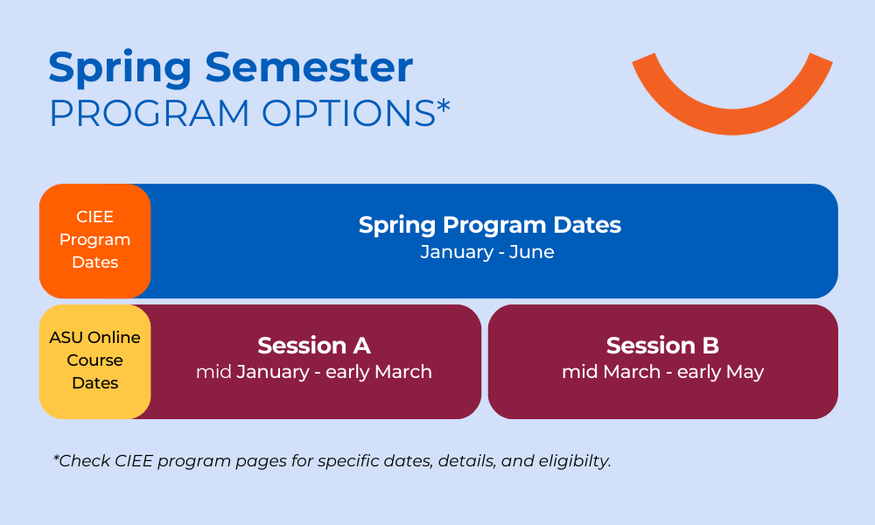
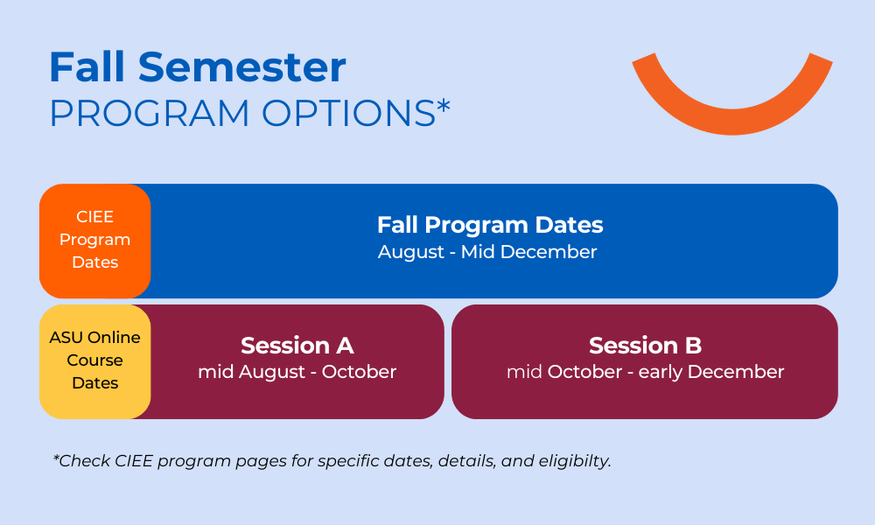
CIEE proudly partners with ASU to deliver asynchronous, online coursework that aligns with your degree requirements from anywhere you study abroad.
CIEE and ASU offer courses online per program eligibility, at no additional charge. Be sure to review online courses with your home school advisor.
Check the CIEE Program Dates and ASU start dates below to maximize course options within your program!
Search ASU Online Courses BROWSE FAQs for more INFO
Note: This course listing is for informational purposes only and does not constitute a contract between CIEE and any applicant, student, institution, or other party. The courses, as described, may be subject to change as a result of ongoing curricular revisions, assignment of lecturers and teaching staff, and program development. Courses may be canceled due to insufficient enrollment.
"(GI)" denotes courses that originated at CIEE's Global Institutes and that are offered at multiple CIEE sites.
Scholarships & Grants
CIEE offers scholarships and grants annually to help students like you make your study abroad dream a reality.
Students who apply to this program are eligible for the following scholarships and grants:
- Wollitzer Merit Scholarships in Area or Comparative Studies
- Ping Scholarships for Academic Excellence
- Global Access Initiative (GAIN) Travel Grants
- Stohl International Undergraduate Research Scholarships
- CIEE Gilman Go Global Grant
- Global Access Initiative (GAIN) Scholars Grants
To be considered, submit the CIEE Scholarships & Grants application within your CIEE program application.
Dates & Fees
You get more for every dollar when you study abroad with CIEE, because our high-quality programs include everything from excursions to insurance. There are no hidden charges, and no disappointing surprises when you arrive.
Program |
Application Due |
Start Date |
End Date |
Fees & Housing |
|---|---|---|---|---|
| Program Spring 2027 20 weeks | Application Due Deadline Passed | Start Date | End Date | Fees & Housing $21,450 |
| Program Fall 2027 18 weeks | Start Date * | End Date * | Fees & Housing $21,450 | |
| Program Calendar year 2027 | Application Due Deadline Passed | Start Date * | End Date TBD* | |
| Program Spring 2028 20 weeks | Start Date * | End Date * | ||
| Program Fall 2026 19 weeks | Application Due Deadline Passed | Start Date | End Date | Fees & Housing $20,950 |
*Dates for this program are provided as tentative dates. Please consult with your study abroad advisor to confirm dates before purchasing your flights.
To help you budget, keep in mind that students are responsible for the cost of international airfare, local transportation, books and supplies, visas, and personal expenses. In addition, your college or university may charge additional fees for study abroad, or may require you to receive a transcript via CIEE's School of Record, which carries an additional fee of $500.
Program Fees
CIEE offers the most student support of any provider in its program fee, including an airport greeting, full-time leadership and support, orientation, cultural activities, local excursions, pre-departure advising, and CIEE iNext travel protection with benefits.
| Participation Confirmation | $500 * |
| Educational Costs | $15,756 ** |
| Housing | $5,000 *** |
| Insurance | $194 |
| Total Fees | $21,450 |
Financial Aid
CIEE offers the most grants and scholarships of any study abroad organization, including $8 million/year in travel grants, merit-based scholarships, institutional grants, and Gilman Go Global Grants.
Estimated Costs
Students are responsible and manage costs related to travel, meals, books, and personal expenses. Below are estimates for consideration.
| Meals not included in program fee | $1,845 † |
| International Airfare | $1,450 †† |
| Local Transportation | $500 |
| Books & Supplies | $100 |
| Visa Fees | $135 |
| Potential travel to consulate for visa | $500 ††† |
| Personal expenses | $1,048 †††† |
| Total Costs | $5,578 |
*non-refundable fee
**Direct cost of education charged uniformly to all students
***Housing fees listed are for financial aid purposes only and should not be considered a basis for calculation of refunds.
†The listed estimated cost is for groceries if you plan on making your own meals ($1,485) and the optional estimated cost for dining out once per week ($360). Budget more money if you plan on eating out regularly.
††round-trip based on U.S. East Coast departure
†††If no consulate in your home area
††††Personal expenses may include but are not limited to the following: taxis, social activities and entertainment, toiletries, cell phone. Does not include personal travel.
Program Fees
CIEE offers the most student support of any provider in its program fee, including an airport greeting, full-time leadership and support, orientation, cultural activities, local excursions, pre-departure advising, and CIEE iNext travel protection with benefits.
| Participation Confirmation | $500 * |
| Educational Costs | $15,756 ** |
| Housing | $5,000 *** |
| Insurance | $194 |
| Total Fees | $21,450 |
Financial Aid
CIEE offers the most grants and scholarships of any study abroad organization, including $8 million/year in travel grants, merit-based scholarships, institutional grants, and Gilman Go Global Grants.
Estimated Costs
Students are responsible and manage costs related to travel, meals, books, and personal expenses. Below are estimates for consideration.
| Meals not included in program fee | $1,845 † |
| International Airfare | $1,450 †† |
| Local Transportation | $500 |
| Books & Supplies | $100 |
| Visa Fees | $135 |
| Potential travel to consulate for visa | $500 ††† |
| Personal expenses | $1,048 †††† |
| Total Costs | $5,578 |
*non-refundable fee
**Direct cost of education charged uniformly to all students
***Housing fees listed are for financial aid purposes only and should not be considered a basis for calculation of refunds.
†The listed estimated cost is for groceries if you plan on making your own meals ($1,485) and the optional estimated cost for dining out once per week ($360). Budget more money if you plan on eating out regularly.
††round-trip based on U.S. East Coast departure
†††If no consulate in your home area
††††Personal expenses may include but are not limited to the following: taxis, social activities and entertainment, toiletries, cell phone. Does not include personal travel.
Program Fees
CIEE offers the most student support of any provider in its program fee, including an airport greeting, full-time leadership and support, orientation, cultural activities, local excursions, pre-departure advising, and CIEE iNext travel protection with benefits.
Financial Aid
CIEE offers the most grants and scholarships of any study abroad organization, including $8 million/year in travel grants, merit-based scholarships, institutional grants, and Gilman Go Global Grants.
Estimated Costs
Students are responsible and manage costs related to travel, meals, books, and personal expenses. Below are estimates for consideration.
Program Fees
CIEE offers the most student support of any provider in its program fee, including an airport greeting, full-time leadership and support, orientation, cultural activities, local excursions, pre-departure advising, and CIEE iNext travel protection with benefits.
Financial Aid
CIEE offers the most grants and scholarships of any study abroad organization, including $8 million/year in travel grants, merit-based scholarships, institutional grants, and Gilman Go Global Grants.
Estimated Costs
Students are responsible and manage costs related to travel, meals, books, and personal expenses. Below are estimates for consideration.
Program Fees
CIEE offers the most student support of any provider in its program fee, including an airport greeting, full-time leadership and support, orientation, cultural activities, local excursions, pre-departure advising, and CIEE iNext travel protection with benefits.
| Participation Confirmation | $300 * |
| Educational Costs | $16,206 ** |
| Housing | $4,250 *** |
| Insurance | $194 |
| Total Fees | $20,950 |
Financial Aid
CIEE offers the most grants and scholarships of any study abroad organization, including $8 million/year in travel grants, merit-based scholarships, institutional grants, and Gilman Go Global Grants.
Estimated Costs
Students are responsible and manage costs related to travel, meals, books, and personal expenses. Below are estimates for consideration.
| Meals not included in program fee | $1,401 † |
| International Airfare | $1,450 †† |
| Local Transportation | $500 |
| Books & Supplies | $100 |
| Visa Fees | $135 |
| Potential travel to consulate for visa | $500 ††† |
| Personal expenses | $240 †††† |
| Total Costs | $4,326 |
*non-refundable fee
**Direct cost of education charged uniformly to all students
***Housing fees listed are for financial aid purposes only and should not be considered a basis for calculation of refunds.
†For groceries if you plan on making your own meals, budget more money if you plan on eating out regularly.
††round-trip based on U.S. East Coast departure
†††If no consulate in your home area
††††$100 emergency fund + cell phone expense + toiletries
What's Included
Tuition
Housing
Pre-departure Advising
Advising before you depart to set goals and answer questions
Optional on-site airport meet-and-greet
Orientation
Introduction to your program plus practical information about living in your host city
On-site Staff
Full-time program leadership and support in your city
Cultural and/or Co-curricular Activities
Excursions and/or Study Tours
Travel Protection
CIEE iNext travel protection
24/7 emergency on-site support
Our Staff

Thandeka Dladla
Student Life Manager
Thandeka Dladla has a strong foundation in education, youth development, and program coordination. She holds a bachelor’s degree in music from UCT and has taught learners across primary, high school...
Get Started
1
2
Connect With Your Campus Study Abroad Office
Share your plans and confirm you're on track to meet all required steps to go abroad.
3
Contact Us
Send us an email if you still have questions or need information about applying to this program.
You might also like

- Cape Town, South Africa
- Study Program
- Part-Time Internship
...for 1, 2, or 3 term blocks!

- Study Program
- Part-Time Internship

- Study Program