
Language + Culture
AACSB Accredited

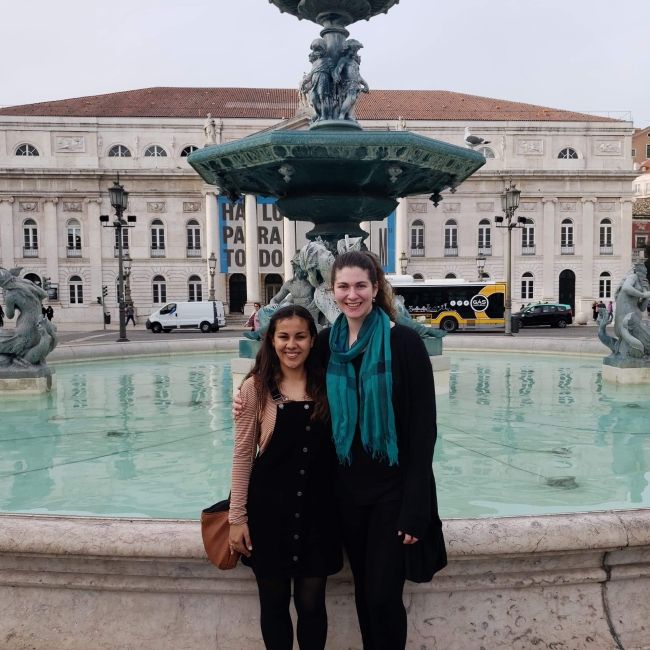


Unique Experiences
Embrace Lisbon’s timeless charms
by discovering the perfect blend of ancient traditions and modern innovations in this cosmopolitan city
Dive into Lisbon's art scene
with guided tours and explore the melancholic sounds of Fado, a traditional Portuguese music genre
Live with a Portuguese family
and immerse yourself in local culture

Your Destination
Lisbon is Portugal’s cosmopolitan city, celebrated for its rich history, diverse artistic heritage, and dynamic cultural scene. From the medieval streets of Alfama to the surrealist works of artists and writers, the city offers endless inspiration for students studying literature, history, philosophy, the arts, and more. Whether you're exploring the Jerónimos Monastery and other architectural masterpieces or engaging with the city's thriving literary and artistic communities, Lisbon is the perfect place to study language and culture abroad.

Program Highlights
- Academic Courses: Choose from CIEE courses, host institution courses, and online courses delivered by CIEE’s global partner, ASU, that align with your academic major.
- Optional Internship Placements: Enhance your program with an optional for-credit internship that aligns with your career aspirations.
- Immersive Experiences: Participate in activities, excursions, study tours, and more that showcase your host city's culture, values, and local art, film, music, cuisine, and sports scenes.
- Cultural Projects: Volunteer with members of the local community, join student clubs to socialize with your peers, and attend local workshops and events to get to know your host city.

Excursions & Activities
CIEE’s excursions and cultural activities in Lisbon will open doors for you to explore Portugal's rich diversity, language, culture, history, and timeless beauty in ways that will enhance your time abroad.
Samples of past excursions and activities:
- Explore a Romanesque cathedral and gilded Baroque altarpieces during a tour of Évora, a historical center surrounded by 16th-century walls
- Get to know Setúbal, a town south of Lisbon, known for its beautiful coast and wonderful cuisine
- Experience the soul of Portugal with an intimate Fado performance, the traditional music genre which is a UNESCO-recognized art form
Please note: Activities are based on past programs and are subject to change at CIEE's discretion to adapt to local circumstances and participant feedback. Our goal when arranging activities is always to enhance your experience.
Program Blogs

Portugal vs. Spain Study Abroad: Which is Better?
Portugal and Spain are both incredible European destinations that offer an immersive study abroad experience. From their histories, cuisines, architecture, cultural events, and more, exploring Portugal or Spain will be... keep reading

Is The Architecture Speaking To Me?
By: Jordan Williams When I saw that my blog post was due, I was inspired by the possibility of a Black woman becoming a U.S. presidential candidate. Over fall break... keep reading

3 Lessons Learned from Studying Abroad
By: Josephine White #1: Do the Homestay, Seriously. When I say do a homestay, I mean it with every fiber of my being. Study abroad isn’t just about traveling and... keep reading
Housing & Meals
Housing
CIEE Lisbon offers diverse housing options to ensure you're comfortable in your home away from home. From homestays to residence halls, we will try our best to meet your accommodation preferences. Additionally, all housing options are located in neighborhoods with convenient access to public transportation, shops, cafés, and eateries.
Standard Housing: Includes a single room at a homestay or a single room with private bathroom at a student residence hall, both located within 50 minutes by public transportation from CIEE Lisbon.
- Homestays offer socially active hosts and a cultural resource who allow for a lot of student independence, no curfew, kitchen access for food storage, a living room, Wi-Fi, weekly laundry, and a bathroom shared with the host. Hosts provide breakfast and dinner.
- Student Dorms are modern, offer Wi-Fi access, and typically have kitchens, study rooms, gyms, laundry facilities and other common areas shared with other students.
Select Housing: Includes a single room with private bathroom at a student residence hall located within 30 minutes by public transportation from CIEE Lisbon or a double shared room at a residence hall located within 15 minutes from CIEE Lisbon. Select housing requires an additional fee.
- Student Dorms are modern, offer Wi-Fi access and typically have kitchens, study rooms, gyms, laundry facilities and other common areas shared with other students.
Select Plus Housing: Includes a single room with kitchenette and en-suite bathroom at a residence hall located within 15 minutes from CIEE Lisbon. Select plus housing requires an additional fee.
- Student Dorms are modern, offer Wi-Fi access and typically have kitchens, study rooms, gyms, laundry facilities and other common areas shared with other students.
A note: The default criterion to assign housing is first-come, first-served; however, other factors may also be considered. If we cannot accommodate your first housing choice, we'll let you know before you arrive. Non-standard housing options require an additional fee that can be found in the program Dates and Fees.
Meals
- Homestay: Breakfasts and dinners are provided seven days a week. Dietary needs may be accommodated.
- Residence Hall: Meals are not included.
All students have access to the subsidized cafeteria on campus. All housing options provide internet access.





Academics
CIEE Lisbon: Study on the campus of the Universidade Nova de Lisboa School of Social Sciences and Humanities (NOVA FCSH), CIEE’s partner institution, located near trendy cafés, shops, banks, a modest shopping mall, and two metro lines that access the rest of the city. CIEE Lisbon features several offices on campus, namely with academic advising and student life support services, and access to NOVA FCSH’s campus library, study spaces, cafeteria, and coffee shop.
NOVA FCSH - Faculdade de Ciências Sociais e Humanas: Universidade Nova de Lisboa was founded in 1977 and is now one of the highest-ranking social sciences and humanities schools in Portugal. It is dedicated to education, scientific research, and cultural creation. Courses are taught in Portuguese. The school hosts more than 2,800 undergraduate students and 16 research centers and is located in the heart of Lisbon.
Instituto Superior de Ciências do Trabalho e de Empresas - Instituto Universitário de Lisboa (ISCTE-IUL) is a public university established in 1972, pursuing teaching, research, and community service activities with scientific and pedagogical expertise. ISCTE-IUL offers a range of courses taught in English from areas such as business and economics to political science and psychology. ISCTE-IUL has been recognized by highly reputed foreign agencies and associations.
ISEG - Lisbon School of Economics and Management offers a dynamic academic environment in Lisbon, focusing on economics, finance, and management. The institution provides English-taught programs, fostering international perspectives and practical skills to prepare students for a competitive global job market, with a strong emphasis on critical thinking and, in some cases, sustainable development. ISEG has been awarded the Triple Crown of Accreditations (Equis, AACSB, AMBA).
Arizona State University (ASU): Brought to you by CIEE in partnership with ASU, enhance your international coursework with online classes that align with your degree requirements. ASU offers thousands of online courses in asynchronous 7.5-week sessions that fit within the CIEE academic calendar.
Course Information
You will finalize registration for host institution courses before arriving on site. Check the list below for more information on the host institution courses:
NOVA FCSH
- Courses are taught mostly in Portuguese and you may take up to 4 courses if approved based on your background, placement exam, and final approval by CIEE and NOVA FCSH.
- Some classes may be held on a secondary campus, a 20-minute walk or free shuttle ride away.
ISCTE-IUL
- Courses are taught in English, and you may take up to 2 courses.
- Requires a 20-minute walk from the NOVA FCSH campus.
- A3ES, AACSB, and AMBA accreditation.
Academic Projects
Biological and Physical Sciences
Business, Economics, Management, and Marketing
Engineering and Engineering Technologies
History, Philosophy, Religion
Languages and Cultural Studies
Social Sciences
Visual and Performing Arts
Agriculture
Communication, Journalism, and Media
Natural Resources, Conservation, and the Environment
Psychology
Academic Projects
Biological and Physical Sciences
Business, Economics, Management, and Marketing
History, Philosophy, Religion
Languages and Cultural Studies
Social Sciences
Visual and Performing Arts
Agriculture
Communication, Journalism, and Media
Natural Resources, Conservation, and the Environment
Psychology
Academic Projects
Biological and Physical Sciences
Business, Economics, Management, and Marketing
History, Philosophy, Religion
Languages and Cultural Studies
Social Sciences
Visual and Performing Arts
Agriculture
Communication, Journalism, and Media
Natural Resources, Conservation, and the Environment
Psychology
IMPORTANT NOTE ABOUT HOST INSTITUTION COURSES
Host institution courses end later than CIEE courses, with exams held after program end dates. Students must complete all work before leaving, confirm exam dates early, and follow continuous assessment – no single-exam pass option. Information displayed on the official websites of host institutions may differ from the actual course offerings made available. Housing will be guaranteed for you until the date of your exam (December for Fall and May, early June for Spring).
NOVA School of Social Sciences – Universidade Nova de Lisboa (NOVA-FCSH)
CIEE students have the option to take up to four courses from any of the 14 social science departments at the Faculdade de Ciências Sociais e Humanas - Universidade Nova de Lisboa (NOVA FCSH). NOVA FCSH courses are typically taught in Portuguese for 3 semester credits each.
The courses listed below are representative of courses historically available at FCSH-UNL but CIEE cannot guarantee specific courses are offered each semester. Visit the website for information on departments and classes available. Course registration occurs on-site.
Anthropology
- Anthropology and Colonialism
- Anthropology of the Family and Relatives
- Anthropology and Human Rights
- Anthropology of Religion
- Anthropology of Space
- Contemporary Portuguese Anthropology
- Economic Anthropology
- Ethnicity and Nationalism
- History of Anthropology
- Political Anthropology
- Urban Anthropology
Archaeology
- Industrial Archaeology
- Medieval Muslim Archaeology
- Modern Archaeology
- Roman Imperial Archaeology
Art History
- Culture and Contemporary Art
- History of Colonial Art
- History of Gothic Art
- History of Non-Western Art
- Introduction to Museology
Communications
- Communications and Social Science
- History of Media
- Sociology of Communications
- Theory of News
Geography
- Climatology
- Geography of Rural Space
- Geomorphology
- Human Geography
- Physical Geography of Portugal
- Urban Geography
History
- Contemporary History
- History of Contemporary Portugal
- History of Medieval Portugal
- History of Modern Portugal
- History of Portuguese Expansion
International Relations/Political Science
- Contemporary International Politics
- History of the Idea of Europe
- History of Political Ideas
- History of Portuguese International Relations
- History and Theory of State in Portugal
- Political Systems
- Portuguese Political Thought
- Security Studies, International Institutions
Language, Literature, and Culture
- Brazilian Literature
- English
- French
- German
- Portuguese Culture
- Portuguese Language and Culture
- Portuguese Linguistics
- Spanish
Music History/Ethnomusicology
- Ethnomusicology
- History of Music in Portugal
- Music and Information
- Musical Cultures of the World
- Philosophy and Music
Philosophy
- Philosophy and Culture in Portugal
Sociology
- Class and Social Structure
- Contemporary Social Themes
Translation
- History of Translation
- Introduction to Terminology in the Social Sciences and Humanities
- Linguistic Diversity in the Iberian Peninsula
Instituto Superior de Ciências do Trabalho e de Empresas – Instituto Universitário de Lisboa (ISCTE-IUL)
Students have the option to take up to two courses taught in English at ISCTE-IUL, which are typically 3 semester credits each. Visit the website and click on the appropriate semester. CIEE cannot guarantee that all classes will be offered every semester. Course registration occurs on-site.
Below you will find a sample course list of ISCTE-IUL courses recommended for study abroad students.
Business School
- Marketing Management
- Fundamentals Finance
- Taxation for Non-Residents
- Business Law
- Human Resources Management
- International Human Resources Management
- Management in International Organizations
- Comparative International Management
- Marketing Services
- Applied Corporate Finance
- Health Economics
- Game Theory and Economic Applications
School of Social Sciences
- Crisis and Catastrophe - Anthropological Readings
- Colonization and Decolonization: XIX-XX Centuries
- Crisis and Catastrophe - Anthropological Readings
- Minorities of Southeast Asia
- Understanding Culture: Readings in Art and Fairytales
- Europe and the World in the Nineteenth Century
- History of Portuguese Expansion
- Israel/Palestine: History, Anthropology, Politics
- Portuguese History and Culture
- Psychopathology
School of Sociology and Public Policy
- Public Policies of Culture
- Social Movements in the Digital Era
- Sociology of Law
- Using Graphic Methods in the Social Sciences
- World Economy XIX and XXth Centuries
ISEG – Lisbon School of Economics and Management
Please note: not all courses are available every term.
Sample List of Courses:
- Corporate Finance
- Topics in Development Economics
- Money and Banking
- Management of Innovation
- Urban Economics
- Environmental Sustainability for Business
- Management Accounting
- Social Network Analysis
- Operational Marketing
- Data Analysis for Economics and Business
- Experimental Economics
- Econometrics
- Sustainable Finance
- Global Economic History of Portugal
The full list of courses available on the ISEG website.
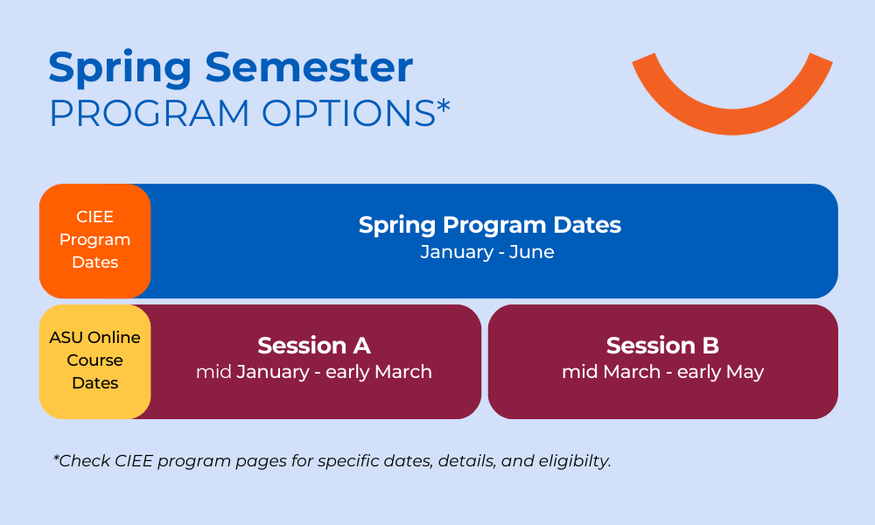
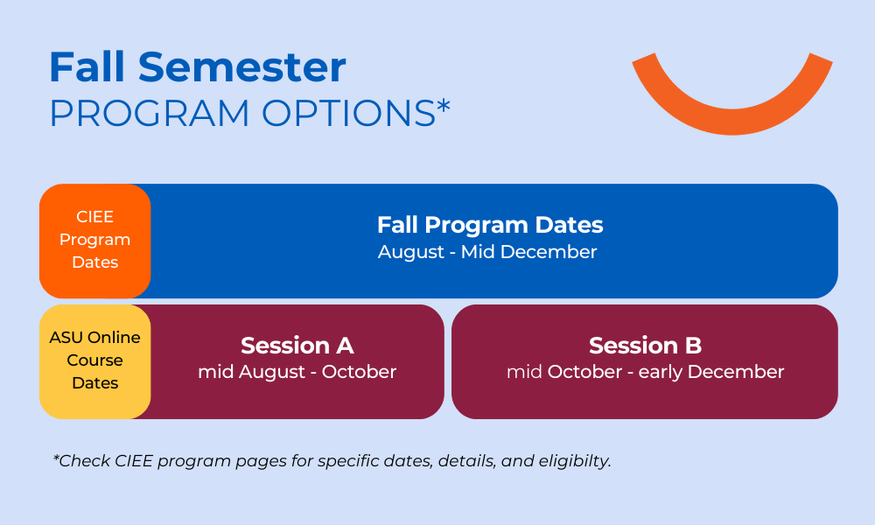
CIEE proudly partners with ASU to deliver asynchronous, online coursework that aligns with your degree requirements from anywhere you study abroad.
CIEE and ASU offer courses online per program eligibility, at no additional charge. Be sure to review online courses with your home school advisor.
Check the CIEE Program Dates and ASU start dates below to maximize course options within your program!
Search ASU Online Courses BROWSE FAQs for more INFO
Note: This course listing is for informational purposes only and does not constitute a contract between CIEE and any applicant, student, institution, or other party. The courses, as described, may be subject to change as a result of ongoing curricular revisions, assignment of lecturers and teaching staff, and program development. Courses may be canceled due to insufficient enrollment.
"(GI)" denotes courses that originated at CIEE's Global Institutes and that are offered at multiple CIEE sites.
Discover Internship Opportunities
We're excited you're considering this program! Next, explore the types of internships you can choose from for an epic internship abroad with CIEE Study Abroad.
Explore Industry Options
Lisbon is a burgeoning tech hub, home to numerous startups and coworking spaces that foster creativity and collaboration. This city is ideal for entrepreneurs and established businesses alike. Beyond work, the city’s beautiful weather, rich culture, and affordable living make it an attractive place to reside.

Business Management and Administration
Study international business practices, multicultural leadership, and global market dynamics.

Education and Training
Experience international teaching methodologies and curriculum development in classrooms around the globe.

Health Science
Immerse yourself in global healthcare systems to study cross-border medical practices and address public health challenges.

Marketing, Sales and Service
Explore global market dynamics, cross-cultural consumer engagement, and sales techniques in firms, agencies, and companies.
Browse Internship Opportunities
Explore internship placements available through this program to find the right fit for your academic and professional goals.
Disclaimer: Internship placements are subject to availability and host employer hiring discretion. Application and payment of CIEE fees does not guarantee specific placement. This internship listing is for informational purposes only and does not constitute a contract between CIEE and any applicant, student, institution, or other party.
Scholarships & Grants
CIEE offers scholarships and grants annually to help students like you make your study abroad dream a reality.
Students who apply to this program are eligible for the following scholarships and grants:
- Ping Scholarships for Academic Excellence
- Global Access Initiative (GAIN) Travel Grants
- CIEE Gilman Go Global Grant
- Global Access Initiative (GAIN) Scholars Grants
To be considered, submit the CIEE Scholarships & Grants application within your CIEE program application.
Dates & Fees
You get more for every dollar when you study abroad with CIEE, because our high-quality programs include everything from excursions to insurance. There are no hidden charges, and no disappointing surprises when you arrive.
Program |
Application Due |
Start Date |
End Date |
Fees & Housing |
|---|---|---|---|---|
| Program Spring 2027 15 weeks | Application Due Deadline Passed | Start Date | End Date | Fees & Housing $20,450 |
| Program Fall 2027 15 weeks | Start Date * | End Date * | Fees & Housing $20,450 | |
| Program Academic year 2027-2028 36 weeks | Start Date * | End Date * | ||
| Program Spring 2028 15 weeks | Start Date * | End Date * | ||
| Program Fall 2026 15 weeks | Application Due Deadline Passed | Start Date | End Date | Fees & Housing $19,950 |
| Program Academic year 2026-2027 36 weeks | Application Due Deadline Passed | Start Date | End Date | Fees & Housing $39,375 |
*Dates for this program are provided as tentative dates. Please consult with your study abroad advisor to confirm dates before purchasing your flights.
To help you budget, keep in mind that students are responsible for the cost of international airfare, local transportation, books and supplies, visas, and personal expenses. In addition, your college or university may charge additional fees for study abroad, or may require you to receive a transcript via CIEE's School of Record, which carries an additional fee of $500.
Program Fees
CIEE offers the most student support of any provider in its program fee, including an airport greeting, full-time leadership and support, orientation, cultural activities, local excursions, pre-departure advising, and CIEE iNext travel protection with benefits.
| Participation Confirmation | $500 * |
| Educational Costs | $15,106 ** |
| Housing | $4,650 *** |
| Insurance | $194 |
| Total Fees | $20,450 |
Optional Housing
CIEE accommodation options are detailed in the Housing section. Based on availability, Select or Select Plus Housing can be chosen during the application process for an additional fee. Housing is assigned on a first-come, first-served basis; however, other factors may also be considered.
| Select Housing Fee | $2,250 |
| Select Plus Housing Fee | $3,375 |
Financial Aid
CIEE offers the most grants and scholarships of any study abroad organization, including $8 million/year in travel grants, merit-based scholarships, institutional grants, and Gilman Go Global Grants.
Estimated Costs
Students are responsible and manage costs related to travel, meals, books, and personal expenses. Below are estimates for consideration.
| Meals not included in program fee | $1,500 † |
| International Airfare | $1,100 †† |
| Local Transportation | $120 ††† |
| Books & Supplies | $50 |
| Visa Fees | $325 |
| Potential travel to consulate for visa | $500 |
| Personal expenses | $1,013 †††† |
| Total Costs | $4,608 |
*non-refundable fee
**Direct cost of education charged uniformly to all students
***Housing fees listed are for financial aid purposes only and should not be considered a basis for calculation of refunds.
†The listed estimated cost is for students in homestays and the additional optional cost for dining out once per week ($450). Families provide 2 meals (breakfast and dinner) and students purchase lunch (there isn’t usually access to a kitchen). For students in dorms, you should budget approx. $300 per month for groceries if you plan on making your own meals, and more if you plan on eating out regularly.
††round-trip based on U.S. East Coast departure
†††Student transportation card
††††Personal expenses may include but are not limited to the following: taxis, social activities and entertainment, toiletries, cell phone. Does not include personal travel.
Program Fees
CIEE offers the most student support of any provider in its program fee, including an airport greeting, full-time leadership and support, orientation, cultural activities, local excursions, pre-departure advising, and CIEE iNext travel protection with benefits.
| Participation Confirmation | $500 * |
| Educational Costs | $15,106 ** |
| Housing | $4,650 *** |
| Insurance | $194 |
| Total Fees | $20,450 |
Financial Aid
CIEE offers the most grants and scholarships of any study abroad organization, including $8 million/year in travel grants, merit-based scholarships, institutional grants, and Gilman Go Global Grants.
Estimated Costs
Students are responsible and manage costs related to travel, meals, books, and personal expenses. Below are estimates for consideration.
| Meals not included in program fee | $1,400 † |
| International Airfare | $1,100 †† |
| Local Transportation | $140 ††† |
| Books & Supplies | $50 |
| Visa Fees | $325 |
| Potential travel to consulate for visa | $500 |
| Personal expenses | $1,005 †††† |
| Total Costs | $4,520 |
*non-refundable fee
**Direct cost of education charged uniformly to all students
***Housing fees listed are for financial aid purposes only and should not be considered a basis for calculation of refunds.
†The listed estimated cost is for students in homestays, families provide 2 meals a day and the optional estimated cost for dining out once per week ($420). For students in apartments/residence halls, you should budget approx. $300 per month for groceries if you plan on making your own meals, and more if you plan on eating out regularly.
††round-trip based on U.S. East Coast departure
†††Student transportation card
††††Personal expenses may include but are not limited to the following: taxis, social activities and entertainment, toiletries, cell phone. Does not include personal travel.
Program Fees
CIEE offers the most student support of any provider in its program fee, including an airport greeting, full-time leadership and support, orientation, cultural activities, local excursions, pre-departure advising, and CIEE iNext travel protection with benefits.
Financial Aid
CIEE offers the most grants and scholarships of any study abroad organization, including $8 million/year in travel grants, merit-based scholarships, institutional grants, and Gilman Go Global Grants.
Estimated Costs
Students are responsible and manage costs related to travel, meals, books, and personal expenses. Below are estimates for consideration.
Program Fees
CIEE offers the most student support of any provider in its program fee, including an airport greeting, full-time leadership and support, orientation, cultural activities, local excursions, pre-departure advising, and CIEE iNext travel protection with benefits.
Financial Aid
CIEE offers the most grants and scholarships of any study abroad organization, including $8 million/year in travel grants, merit-based scholarships, institutional grants, and Gilman Go Global Grants.
Estimated Costs
Students are responsible and manage costs related to travel, meals, books, and personal expenses. Below are estimates for consideration.
Program Fees
CIEE offers the most student support of any provider in its program fee, including an airport greeting, full-time leadership and support, orientation, cultural activities, local excursions, pre-departure advising, and CIEE iNext travel protection with benefits.
| Participation Confirmation | $300 * |
| Educational Costs | $15,206 ** |
| Housing | $4,250 *** |
| Insurance | $194 |
| Total Fees | $19,950 |
Optional Housing
CIEE accommodation options are detailed in the Housing section. Based on availability, Select or Select Plus Housing can be chosen during the application process for an additional fee. Housing is assigned on a first-come, first-served basis; however, other factors may also be considered.
| Select Housing Fee | $2,250 |
| Select Plus Housing Fee | $3,375 |
Financial Aid
CIEE offers the most grants and scholarships of any study abroad organization, including $8 million/year in travel grants, merit-based scholarships, institutional grants, and Gilman Go Global Grants.
Estimated Costs
Students are responsible and manage costs related to travel, meals, books, and personal expenses. Below are estimates for consideration.
| Meals not included in program fee | $1,050 † |
| International Airfare | $1,100 †† |
| Local Transportation | $120 ††† |
| Books & Supplies | $50 |
| Visa Fees | $325 |
| Potential travel to consulate for visa | $500 |
| Personal expenses | $212 †††† |
| Total Costs | $3,357 |
*non-refundable fee
**Direct cost of education charged uniformly to all students
***Housing fees listed are for financial aid purposes only and should not be considered a basis for calculation of refunds.
†For students in homestays, families provide 2 meals (breakfast and dinner). For students in residence halls/apartments, you should budget approx. $300 per month for groceries if you plan on making your own meals, and more if you plan on eating out regularly.
††round-trip based on U.S. East Coast departure
†††Student transportation card
††††$100 emergency fund + cell phone expense + toiletries
Program Fees
CIEE offers the most student support of any provider in its program fee, including an airport greeting, full-time leadership and support, orientation, cultural activities, local excursions, pre-departure advising, and CIEE iNext travel protection with benefits.
| Participation Confirmation | $300 * |
| Educational Costs | $29,981 ** |
| Housing | $8,900 *** |
| Insurance | $194 |
| Total Fees | $39,375 |
Optional Housing
CIEE accommodation options are detailed in the Housing section. Based on availability, Select or Select Plus Housing can be chosen during the application process for an additional fee. Housing is assigned on a first-come, first-served basis; however, other factors may also be considered.
| Select Housing Fee | $2,250 |
| Select Plus Housing Fee | $3,375 |
Financial Aid
CIEE offers the most grants and scholarships of any study abroad organization, including $8 million/year in travel grants, merit-based scholarships, institutional grants, and Gilman Go Global Grants.
Estimated Costs
Students are responsible and manage costs related to travel, meals, books, and personal expenses. Below are estimates for consideration.
| Meals not included in program fee | $1,050 † |
| International Airfare | $1,100 †† |
| Local Transportation | $120 ††† |
| Books & Supplies | $50 |
| Visa Fees | $325 |
| Potential travel to consulate for visa | $500 |
| Personal expenses | $212 †††† |
| Total Costs | $3,357 |
*non-refundable fee
**Direct cost of education charged uniformly to all students
***Housing fees listed are for financial aid purposes only and should not be considered a basis for calculation of refunds.
†For students in homestays, families provide 2 meals (breakfast and dinner). For students in residence halls/apartments, you should budget approx. $300 per month for groceries if you plan on making your own meals, and more if you plan on eating out regularly.
††round-trip based on U.S. East Coast departure
†††Student transportation card
††††$100 emergency fund + cell phone expense + toiletries
What's Included
Tuition
Housing
Pre-departure Advising
Advising before you depart to set goals and answer questions
Optional on-site airport meet-and-greet
Orientation
Introduction to your program plus practical information about living in your host city
On-site Staff
Full-time program leadership and support in your city
Cultural and/or Co-curricular Activities
Excursions and/or Study Tours
Travel Protection
CIEE iNext travel protection
24/7 emergency on-site support
Our Staff

Joana Almeida
Center Director
Joana holds a Ph.D. in Historical Sociology from the University of Lisbon. She has been working at CIEE Lisbon since 2011, first as a faculty member, then as the Academic Director of the center. Having studied and worked abroad herself, she is passionate about international education.

Rodrigo Dias
Academic Manager
Rodrigo has been working for CIEE Lisbon since 2021. He holds a bachelor's degree in Asian Studies and a master's degree in Teaching Portuguese as a Foreign/Second Language. He has dedicated his career to international education and is very passionate about it.

Ana Rita Ribeiro
Senior Program Manager
Ana Rita has been collaborating with CIEE since 2021. She holds a bachelor's degree in biology and a master’s degree in biomedical sciences.
Get Started
1
2
Connect With Your Campus Study Abroad Office
Share your plans and confirm you're on track to meet all required steps to go abroad.
3
Contact CIEE
We're here to help! Send us an email if you still have questions or need information about applying to this program.
4
Interested in an optional internship?
After being accepted to this program and submitting the required internship documents, work with CIEE staff on your internship goals and select which positions to interview for. CIEE will reach out to companies that would be a good fit for you, your interests, and your qualifications. Finalize your internship placement upon arrival!
You might also like

- Lisbon, Portugal
- Study Program
...for 1, 2, or 3 term blocks!

- Study Program
- Part-Time Internship

- Study Program