
Business + Culture
AACSB Accredited


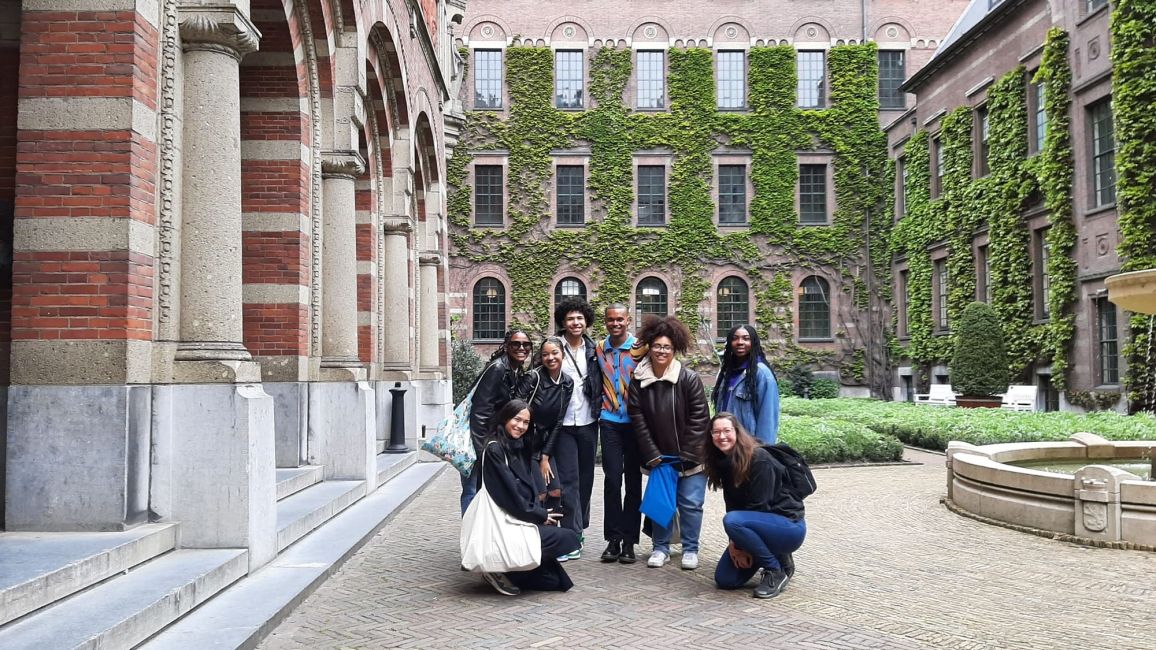
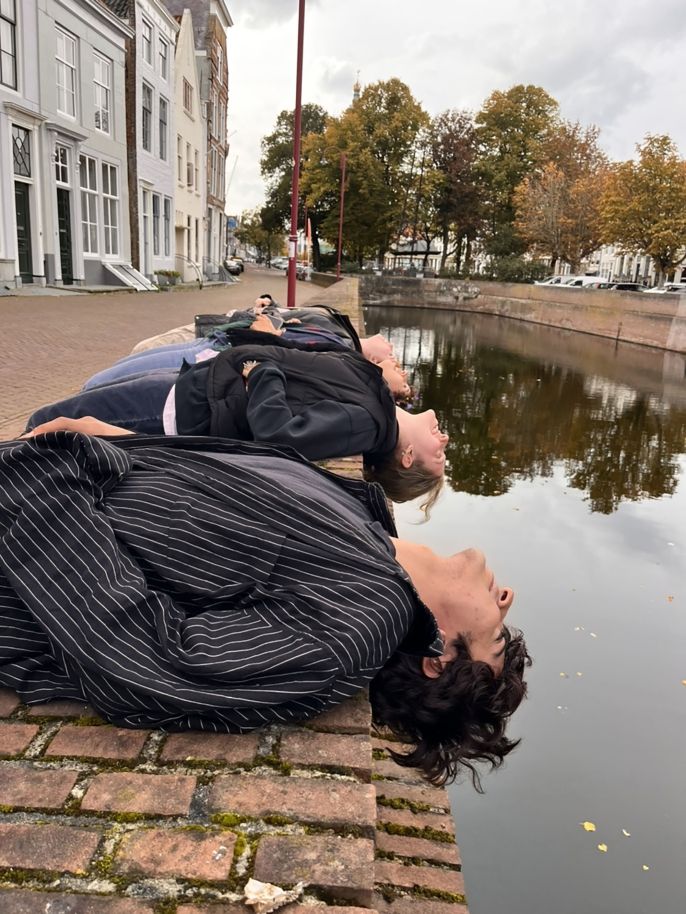
Unique Experiences
Get a multicultural perspective
by living in one of the most diverse and innovative cities in the world
Commute and cruise around by bike
and make the most of an up-close and fast-moving city experience
Join a Dutch family for the weekend
for a personal introduction to Dutch culture and lifestyle

Your Destination
Amsterdam is the Netherlands' cosmopolitan city, renowned for its thriving business landscape and rich cultural heritage. As a global hub for entrepreneurship, finance, and international trade, Amsterdam offers exceptional opportunities for students studying business and culture. The city's unique blend of Dutch traditions, iconic landmarks such as the Anne Frank House and Rijksmuseum, world-class museums, and thriving creative industries make Amsterdam the perfect place to study abroad.

Program Highlights
- Academic Courses: Choose from CIEE courses, host institution courses, and online courses delivered by CIEE’s global partner, ASU, that align with your academic major.
- Immersive Experiences: Participate in activities, excursions, study tours, and more that showcase your host city's culture, values, and local art, film, music, cuisine, and sports scenes.
- Academic Projects: Enroll in an optional for-credit independent research project or service-learning project for increased professional development opportunities.

Excursions & Activities
CIEE’s excursions and cultural activities in Amsterdam will open doors for you to explore the Netherlands' rich diversity, language, culture, history, and timeless beauty in ways that will enhance your time abroad.
Samples of past excursions and activities:
- Slip out of urban life to experience the wonders of Dutch nature during weekend overnight trips
- Go mudflat walking on the floor of the Wadden Sea at the UNESCO World Heritage site of Schiermonnikoog in the spring
- Cycle leisurely through changing landscapes of De Hoge Veluwe National Park in the fall
Please note: Activities are based on past programs and subject to change at CIEE's discretion to adapt to local circumstances and participant feedback. Our goal when arranging activities is always to enhance your experience.
Program Blogs

Embracing Sustainable Travel
By: Mya Cummins When I decided to study abroad in Amsterdam with CIEE, I knew I’d be stepping into a city famous for its canals, art, and rich history. What... keep reading

Reflections on Studying Abroad in Amsterdam
By: Ava Pugh I have the fondest memories of my seventh-grade spring break in Amsterdam, including boat tours on the canals, biking through tulip fields in the Dutch countryside, and... keep reading

Asia vs. Europe Travel: Which is Better for Study Abroad?
Choosing between Asia vs. Europe as the backdrop of your study abroad experience can be quite a challenging decision! Each continent offers unforgettable cultural experiences, immersive academic opportunities, and life-changing... keep reading
Housing & Meals
Housing
While housing is limited in Amsterdam, CIEE Amsterdam offers a variety of housing options throughout the city. All housing is located within a 45-minute commute of CIEE Amsterdam and the city center by public transport or bicycle.
Standard Housing: Includes a private room in a residence hall.
- Residence Halls: West of the city center, in what was once a shipyard district and is now a lively artistic hub right next to the metro. Students live in single rooms with en-suite bathrooms and access to fully equipped shared kitchens and laundry facilities. Additional amenities include free WiFi, gym access, laundry services, bed linens, towels, and a TV.
Select Housing: Includes a room in a residence hall with a private or shared kitchen.
- Students live in single rooms with en-suite bathrooms and access to fully equipped private or shared kitchens and laundry facilities. These rooms offer added amenities and are more spacious than Standard rooms. Commute time to the office varies:
- Single Rooms with Private Kitchen: under a 45-minute commute to CIEE Amsterdam
- Single Rooms with Shared Kitchen: under a 30-minute commute to CIEE Amsterdam.
Select housing requires an upgrade fee.
A note: The default criterion to assign housing is first-come, first-served; however, other factors may also be considered. If we cannot accommodate your first housing choice, we'll let you know before you arrive. Non-standard housing options require an additional fee that can be found in the program Dates and Fees.
Meals
Residence Halls: No meals are included for residence hall residents.
Transportation
Students are responsible for their own travel costs in and around Amsterdam. The best way to travel around the city is by bike. Whatever the weather, the Dutch will steadfastly cycle to work, school, and back home – and you can, too! CIEE staff will fill you in on all your options for getting a bike once you arrive onsite.









Academics
CIEE Amsterdam: Study in the heart of the Plantagebuurt in Amsterdam! CIEE Amsterdam boasts four classrooms, a student lounge with complimentary books, office space, and a charming outdoor patio.
University of Amsterdam (UvA): The University of Amsterdam offers intensive courses across business studies, economics, and finance. UvA is one of the largest broad-based research universities in Amsterdam, one of the top 15 universities in Europe, and is AACSB accredited.
Vrije Universiteit Amsterdam (VU): Vrije Universiteit Amsterdam boasts a strong international environment and with almost 50 Bachelor’s degree programs and more than 150 Master’s degree programs, the VU offers a wide and varied range of study options for both Dutch and international students and is AACSB accredited.
Arizona State University (ASU): Brought to you by CIEE in partnership with ASU, enhance your international coursework with online classes that align with your degree requirements. ASU offers thousands of online courses in asynchronous 7.5-week sessions that fit within the CIEE academic calendar.
Course Information
- The UvA and VU semester runs on a block system, and CIEE students are present only for the first two of the three-semester blocks. The fall semester is the 1st semester of the academic year and therefore starts with block 1. The spring semester is the 2nd semester of the academic year and therefore starts with block 4.
- Most CIEE courses run during the first two blocks of the semester.
- The University of Amsterdam offers courses in different subjects (Business Studies, Economics, Finance, Econometrics, Statistics, and Accounting), referred to as Study Tracks. The courses are for 2nd and 3rd-year students and require a solid background; since the U.S. education system is different, a CIEE student will not always have a background of two years for a certain study program. For that reason, the student’s transcript has to be reviewed by the UvA faculty to decide which Study Track(s) the students are allowed (or possibly not allowed) to take courses from. Detailed information is provided to students upon acceptance into the program.
Academic Projects
Communication, Journalism, and Media
Languages and Cultural Studies
Psychology
Visual and Performing Arts
Business, Economics, Management, and Marketing
Health Professions and Related Programs
Social Sciences
Academic Projects
Communication, Journalism, and Media
Languages and Cultural Studies
Visual and Performing Arts
Business, Economics, Management, and Marketing
Health Professions and Related Programs
Social Sciences
Psychology
Academic Projects
Communication, Journalism, and Media
Languages and Cultural Studies
Visual and Performing Arts
Business, Economics, Management, and Marketing
Health Professions and Related Programs
Social Sciences
Psychology
University of Amsterdam Courses
(Subject to change)
Acceptance to the program does not guarantee course availability. Typically, students are admitted to either the Business and/or Economics track, which allows them to choose 3-5 courses from the respective track. Please contact CIEE for further information.
Business Studies courses
- E-Business
- Marketing Management
- Information and Data Management
- Innovation Management
- Strategy and Organization
Economics courses
- Environmental Economics
- Game Theory
- Macroeconomics
- Microeconomics
- Development Economics
- Labor Economics
- Transition Economics
- Behavioral Economics
- Political Economy: Dialectical Methodology
Finance courses
- Finance 2
- Investment and Portfolio Theory 1
- Investment and Portfolio Theory 2
- Financial Statement Analysis
Mathematics courses
- Mathematics 2 for Economics
Accounting courses
- Management Accounting 1 for Economics
Other
- Corporate Law
For more information about these courses, go to the University of Amsterdam online catalog of courses for international students.
Vrije Universiteit Amsterdam Courses
(Subject to change)
Students who enroll at the VU may choose Business and Economics courses from the complete VU course catalog for exchange students, provided they meet the background and eligibility requirements.
Some of the course titles on offer include:
- Cross-Cultural Marketing
- Business Information Systems
- Consumer Science for Online Commerce
- Inclusive Growth and Sustainability
- Foundations of Business Administration
- Health Economics
- Risk Management in Financial Institutions
- Corporate Governance and Accountability
- Sustainable Supply Chain Management
- Financial Markets and Institutions
Dutch as a Second Language Courses
at the Dutch Language Institute at the University of Amsterdam (INTT)
Pre-Intermediate
For those who have a global understanding of simple, everyday Dutch, and can make themselves understood in simple, everyday Dutch that is still full of mistakes. The aim of the course is to help participants extend a basic vocabulary of Dutch, enable them to understand simple spoken and written Dutch, and teach them how to make themselves understood in simple spoken and written Dutch.
Intermediate
For those who have a reasonable understanding of everyday Dutch and of Dutch used in the media and can make themselves understood in simple everyday Dutch but still make many mistakes. The aim of the course is to help participants extend a basic vocabulary of Dutch, enable them to understand spoken and written Dutch in a variety of familiar contexts, and teach them how to make themselves understood in both spoken and written Dutch.
Pre-Advanced
For those who have a good understanding of everyday Dutch and of Dutch used in the media, and who can make themselves understood in everyday Dutch but still make quite a few mistakes. The aim of the course is to help participants to extend their vocabulary of Dutch, enable them to understand spoken and written Dutch in a variety of contexts, and improve their basic writing and speaking skills.
Advanced
Even those who have a thorough understanding of everyday Dutch and a good understanding of Dutch at an academic level still make systematic mistakes. Therefore, the advanced course can help those students who have a Dutch language background but are still looking to improve. Objectives of the advanced level are to improve participants’ writing and speaking skills. Some attention is paid to reading, listening, and extending vocabulary.
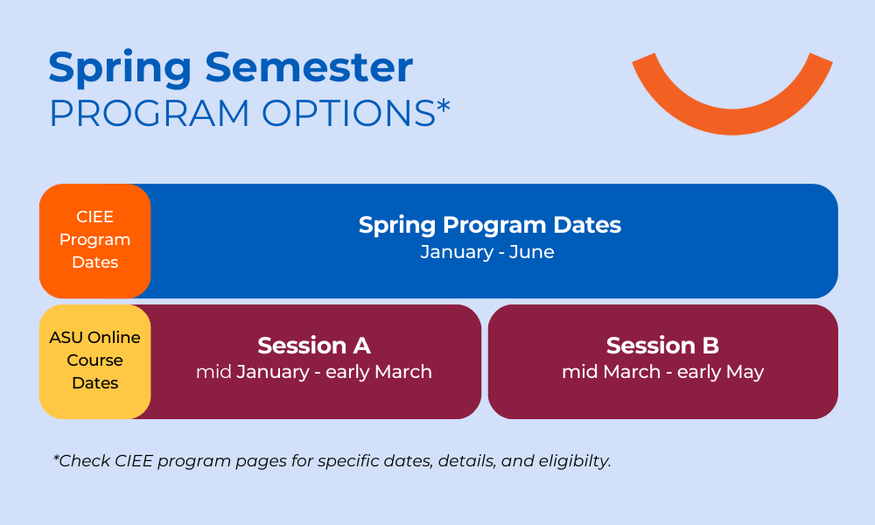
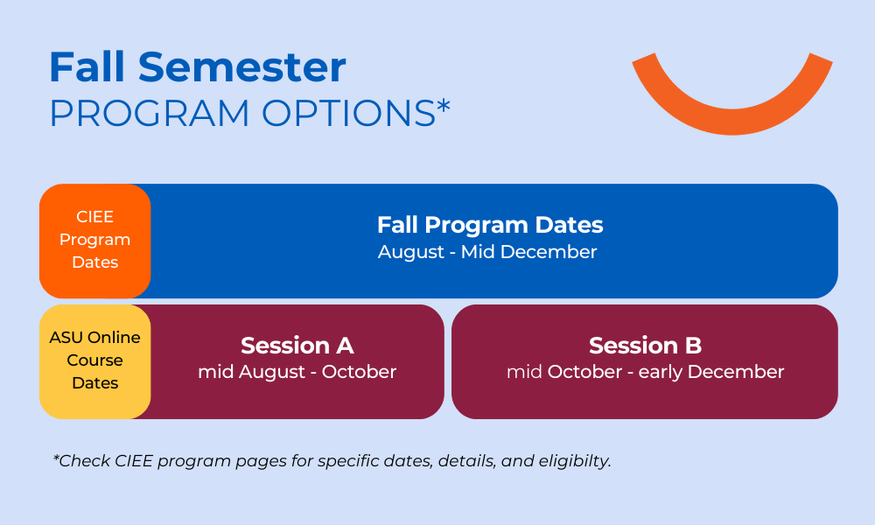
CIEE proudly partners with ASU to deliver asynchronous, online coursework that aligns with your degree requirements from anywhere you study abroad.
CIEE and ASU offer courses online per program eligibility, at no additional charge. Be sure to review online courses with your home school advisor.
Check the CIEE Program Dates and ASU start dates below to maximize course options within your program!
Search ASU Online Courses BROWSE FAQs for more INFO
Note: This course listing is for informational purposes only and does not constitute a contract between CIEE and any applicant, student, institution, or other party. The courses, as described, may be subject to change as a result of ongoing curricular revisions, assignment of lecturers and teaching staff, and program development. Courses may be canceled due to insufficient enrollment.
"(GI)" denotes courses that originated at CIEE's Global Institutes and that are offered at multiple CIEE sites.
Scholarships & Grants
CIEE offers scholarships and grants annually to help students like you make your study abroad dream a reality.
Students who apply to this program are eligible for the following scholarships and grants:
- Ping Scholarships for Academic Excellence
- Global Access Initiative (GAIN) Travel Grants
- CIEE Gilman Go Global Grant
- Global Access Initiative (GAIN) Scholars Grants
To be considered, submit the CIEE Scholarships & Grants application within your CIEE program application.
Dates & Fees
You get more for every dollar when you study abroad with CIEE, because our high-quality programs include everything from excursions to insurance. There are no hidden charges, and no disappointing surprises when you arrive.
Program |
Application Due |
Start Date |
End Date |
Fees & Housing |
|---|---|---|---|---|
| Program Spring 2027 18 weeks | Application Due Deadline Passed | Start Date | End Date | Fees & Housing $24,950 |
| Program Fall 2027 18 weeks | Start Date * | End Date * | Fees & Housing $24,950 | |
| Program Academic year 2027-2028 41 weeks | Start Date * | End Date * | ||
| Program Spring 2028 18 weeks | Start Date * | End Date * | ||
| Program Fall 2026 17 weeks | Application Due Deadline Passed | Start Date | End Date | Fees & Housing $24,950 |
| Program Academic year 2026-2027 40 weeks | Application Due Deadline Passed | Start Date | End Date | Fees & Housing $48,650 |
*Dates for this program are provided as tentative dates. Please consult with your study abroad advisor to confirm dates before purchasing your flights.
To help you budget, keep in mind that students are responsible for the cost of international airfare, local transportation, books and supplies, visas, and personal expenses. In addition, your college or university may charge additional fees for study abroad, or may require you to receive a transcript via CIEE's School of Record, which carries an additional fee of $500.
Program Fees
CIEE offers the most student support of any provider in its program fee, including an airport greeting, full-time leadership and support, orientation, cultural activities, local excursions, pre-departure advising, and CIEE iNext travel protection with benefits.
| Participation Confirmation | $500 * |
| Educational Costs | $14,756 ** |
| Housing | $9,500 *** |
| Insurance | $194 |
| Total Fees | $24,950 |
Optional Housing
CIEE accommodation options are detailed in the Housing section. Based on availability, Select or Select Plus Housing can be chosen during the application process for an additional fee. Housing is assigned on a first-come, first-served basis; however, other factors may also be considered.
| Select Housing Fee | $3,600 |
| Select Plus Housing Fee | $4,500 |
Financial Aid
CIEE offers the most grants and scholarships of any study abroad organization, including $8 million/year in travel grants, merit-based scholarships, institutional grants, and Gilman Go Global Grants.
Estimated Costs
Students are responsible and manage costs related to travel, meals, books, and personal expenses. Below are estimates for consideration.
| Meals not included in program fee | $2,925 † |
| International Airfare | $1,250 †† |
| Local Transportation | $700 ††† |
| Books & Supplies | $200 |
| Visa Fees | $200 |
| Personal expenses | $1,089 †††† |
| Total Costs | $6,364 |
*non-refundable fee
**Direct cost of education charged uniformly to all students
***Housing fees listed are for financial aid purposes only and should not be considered a basis for calculation of refunds.
†The listed estimated cost is for groceries for students in residence halls/apartments if you plan on making your own meals ($470/month) and the optional estimated cost for dining out once per week ($810). Budget more money if you plan on eating out regularly. For students in homestays, families typically provide two meals a day, students should budget $735 to purchase groceries for the remaining meals or more if you plan on eating out regularly.
††round-trip based on U.S. East Coast departure
†††This would cover six round trips per week from students' housing to the UvA campus/the CIEE classroom
††††Personal expenses may include but are not limited to the following: taxis, social activities and entertainment, toiletries, cell phone. Does not include personal travel.
Program Fees
CIEE offers the most student support of any provider in its program fee, including an airport greeting, full-time leadership and support, orientation, cultural activities, local excursions, pre-departure advising, and CIEE iNext travel protection with benefits.
| Participation Confirmation | $500 * |
| Educational Costs | $14,756 ** |
| Housing | $9,500 *** |
| Insurance | $194 |
| Total Fees | $24,950 |
Financial Aid
CIEE offers the most grants and scholarships of any study abroad organization, including $8 million/year in travel grants, merit-based scholarships, institutional grants, and Gilman Go Global Grants.
Estimated Costs
Students are responsible and manage costs related to travel, meals, books, and personal expenses. Below are estimates for consideration.
| Meals not included in program fee | $2,763 † |
| International Airfare | $1,250 †† |
| Local Transportation | $700 ††† |
| Books & Supplies | $200 |
| Visa Fees | $200 |
| Personal expenses | $1,079 †††† |
| Total Costs | $6,192 |
*non-refundable fee
**Direct cost of education charged uniformly to all students
***Housing fees listed are for financial aid purposes only and should not be considered a basis for calculation of refunds.
†The listed estimated cost is for groceries for students in residence halls/apartments if you plan on making your own meals ($470/month) and the optional estimated cost for dining out once per week ($765). Budget more money if you plan on eating out regularly. For students in homestays, families typically provide two meals a day, students should budget $735 to purchase groceries for the remaining meals or more if you plan on eating out regularly.
††round-trip based on U.S. East Coast departure
†††This would cover six round trips per week from students' housing to the UvA campus/the CIEE classroom
††††Personal expenses may include but are not limited to the following: taxis, social activities and entertainment, toiletries, cell phone. Does not include personal travel.
Program Fees
CIEE offers the most student support of any provider in its program fee, including an airport greeting, full-time leadership and support, orientation, cultural activities, local excursions, pre-departure advising, and CIEE iNext travel protection with benefits.
Financial Aid
CIEE offers the most grants and scholarships of any study abroad organization, including $8 million/year in travel grants, merit-based scholarships, institutional grants, and Gilman Go Global Grants.
Estimated Costs
Students are responsible and manage costs related to travel, meals, books, and personal expenses. Below are estimates for consideration.
Program Fees
CIEE offers the most student support of any provider in its program fee, including an airport greeting, full-time leadership and support, orientation, cultural activities, local excursions, pre-departure advising, and CIEE iNext travel protection with benefits.
Financial Aid
CIEE offers the most grants and scholarships of any study abroad organization, including $8 million/year in travel grants, merit-based scholarships, institutional grants, and Gilman Go Global Grants.
Estimated Costs
Students are responsible and manage costs related to travel, meals, books, and personal expenses. Below are estimates for consideration.
Program Fees
CIEE offers the most student support of any provider in its program fee, including an airport greeting, full-time leadership and support, orientation, cultural activities, local excursions, pre-departure advising, and CIEE iNext travel protection with benefits.
| Participation Confirmation | $300 * |
| Educational Costs | $15,456 ** |
| Housing | $9,000 *** |
| Insurance | $194 |
| Total Fees | $24,950 |
Optional Housing
CIEE accommodation options are detailed in the Housing section. Based on availability, Select or Select Plus Housing can be chosen during the application process for an additional fee. Housing is assigned on a first-come, first-served basis; however, other factors may also be considered.
| Select Housing Fee | $3,400 |
| Select Plus Housing Fee | $4,250 |
Financial Aid
CIEE offers the most grants and scholarships of any study abroad organization, including $8 million/year in travel grants, merit-based scholarships, institutional grants, and Gilman Go Global Grants.
Estimated Costs
Students are responsible and manage costs related to travel, meals, books, and personal expenses. Below are estimates for consideration.
| Meals not included in program fee | $2,115 † |
| International Airfare | $1,250 †† |
| Local Transportation | $700 ††† |
| Books & Supplies | $200 |
| Visa Fees | $200 |
| Personal expenses | $290 †††† |
| Total Costs | $4,755 |
*non-refundable fee
**Direct cost of education charged uniformly to all students
***Housing fees listed are for financial aid purposes only and should not be considered a basis for calculation of refunds.
†For students in residence halls/apartments, you should budget approx. $470 per month for groceries if you plan on making your own meals, and more if you plan on eating out regularly. For students in homestays, families typically provide two meals a day, students should budget $735 to purchase groceries for the remaining meals or more if you plan on eating out regularly.
††round-trip based on U.S. East Coast departure
†††This would cover six round trips per week from students' housing to the UvA campus/the CIEE classroom
††††$100 emergency fund + cell phone expense + toiletries
Program Fees
CIEE offers the most student support of any provider in its program fee, including an airport greeting, full-time leadership and support, orientation, cultural activities, local excursions, pre-departure advising, and CIEE iNext travel protection with benefits.
| Participation Confirmation | $300 * |
| Educational Costs | $29,656 ** |
| Housing | $18,500 *** |
| Insurance | $194 |
| Total Fees | $48,650 |
Optional Housing
CIEE accommodation options are detailed in the Housing section. Based on availability, Select or Select Plus Housing can be chosen during the application process for an additional fee. Housing is assigned on a first-come, first-served basis; however, other factors may also be considered.
| Select Housing Fee | $3,400 |
| Select Plus Housing Fee | $4,250 |
Financial Aid
CIEE offers the most grants and scholarships of any study abroad organization, including $8 million/year in travel grants, merit-based scholarships, institutional grants, and Gilman Go Global Grants.
Estimated Costs
Students are responsible and manage costs related to travel, meals, books, and personal expenses. Below are estimates for consideration.
| Meals not included in program fee | $2,115 † |
| International Airfare | $1,250 †† |
| Local Transportation | $700 ††† |
| Books & Supplies | $200 |
| Visa Fees | $200 |
| Personal expenses | $290 †††† |
| Total Costs | $4,755 |
*non-refundable fee
**Direct cost of education charged uniformly to all students
***Housing fees listed are for financial aid purposes only and should not be considered a basis for calculation of refunds.
†For students in residence halls/apartments, you should budget approx. $470 per month for groceries if you plan on making your own meals, and more if you plan on eating out regularly. For students in homestays, families typically provide two meals a day, students should budget $735 to purchase groceries for the remaining meals or more if you plan on eating out regularly.
††round-trip based on U.S. East Coast departure
†††This would cover six round trips per week from students' housing to the UvA campus/the CIEE classroom
††††$100 emergency fund + cell phone expense + toiletries
What's Included
Tuition
Housing
Pre-departure Advising
Advising before you depart to set goals and answer questions
Optional on-site airport meet-and-greet
Orientation
Introduction to your program plus practical information about living in your host city
On-site Staff
Full-time program leadership and support in your city
Cultural and/or Co-curricular Activities
Excursions and/or Study Tours
Travel Protection
CIEE iNext travel protection
24/7 emergency on-site support
Our Staff

Kallan Picha
Center Director

Cathelijn Kuis
Student Life Director
Cathelijn studied Journalism (BA) and American Studies (MA) at the University of Utrecht.
Get Started
1
2
Connect With Your Campus Study Abroad Office
Share your plans and confirm you're on track to meet all required steps to go abroad.
3
Contact Us
Send us an email if you still have questions or need information about applying to this program.
You might also like

- Amsterdam, Netherlands
- Study Program
...for 1, 2, or 3 term blocks!

- Amsterdam, Netherlands
- Study Program

- Amsterdam, Netherlands
- Study Program